
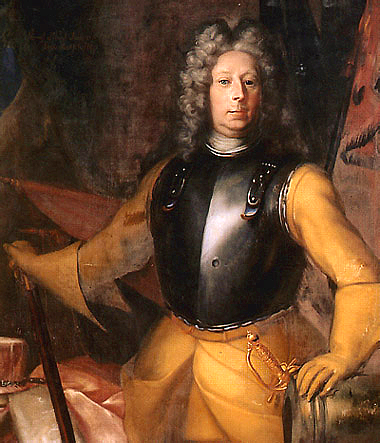
Carl Gustav Rehnskiöld
Carl Gustav Rehnskiöld was a Swedish field marshal. Born August 6, 1651, in Stralsund. Died January 29, 1722, in Kärnbo socken. Educated at Lund University.
Facts
14 facts · 2 confirmed by two sources · 4 cited · 8 from one source
Where this comes from
Papalocal keeps its own record. It started from these sources; what each one said is kept here as it was copied, so a change on their side never changes this page by itself. Tap one to read its version.
What Wikidata says · copied November 16, 2026 · revision 2557829577
- Described as
- Swedish field marshal (1651-1722)
- Born
- August 6, 1651 · 1 reference
- Died
- January 29, 1722 · 1 reference
- Born in
- Stralsund · 1 reference
- Died in
- Kärnbo socken
- Citizen of
- Sweden
- Occupation
- military personnel; military officer · 1 reference; Generalfeldmarschall · 1 reference
- Education
- Lund University
- Father
- Gerdt Anton Rehnskiöld · 1 reference
- Siblings
- Axel Rehnskiöld; Johan Adolf Rehnskiöld
- Military branch
- cavalry · 1 reference
- Military rank
- fältmarskalk
- Wikipedias with a page
- 29
Wikidata item Q434380 (wikidata.org/wiki/Q434380), public domain (CC0). Copied November 16, 2026.
What Wikipedia says · copied November 16, 2026 · revision 1379841527
Count Carl Gustav Rehnskiöld (6 August 1651 – 29 January 1722) was a Swedish Field Marshal (fältmarskalk) and Royal Councillor. He was mentor and chief military advisor to King Charles XII of Sweden, and served as deputy commander-in-chief of the Carolean Army, an army he assisted both in its education and development.
Rehnskiöld grew up in Swedish Pomerania and studied at Lund University under philosopher Samuel von Pufendorf. He entered Swedish war service in 1673 and participated with distinction in the Battles of Halmstad, Lund, and Landskrona during the Scanian War, where he was appointed Lieutenant-Colonel and Adjutant-General. After the war, he was commander of several regiments, observer and tutor to Duke Frederick IV during the Nine Years' War, and Governor-General of Scania.
In the Great Northern War he was Charles XII's right-hand man in the operative organization of the Carolean Army and drafted the battle plans for the landing at Humlebæk and for the battles of Narva, Düna and Kliszów. In the Battle of Fraustadt in 1706, with his own independent army, he decisively defeated a Saxon-Russian Army under the command of Field Marshal Schulenburg. For his services, Rehnskiöld was appointed Field Marshal and the title of Count. During Charles XII's campaign against Russia, Rehnskiöld was in command during the Battle of Holowczyn and the siege of Veprik, where he was severely injured. After Charles XII became incapacitated by a bullet wound, Rehnskiöld replaced him as commander-in-chief of the Swedish Army during the Battle of Poltava in 1709, where it suffered a decisive defeat.
After the battle, Rehnskiöld became a prisoner of war in Russia and spent the years in captivity together with Count Carl Piper by running a management office in Moscow to assist the other Swedish prisoners of war. Rehnskiöld was exchanged in 1718 and arrived at the siege of Fredriksten just before Charles XII was shot to death. Rehnskiöld later served as commander in western Sweden and, suffering from an old shrapnel injury, died in 1722.
- Born, in its opening lines
- August 6, 1651
- Died, in its opening lines
- January 29, 1722
From the Wikipedia article “Carl Gustav Rehnskiöld” (en.wikipedia.org/wiki/Carl_Gustav_Rehnskiöld), by its contributors, under CC BY-SA 4.0 (creativecommons.org/licenses/by-sa/4.0/). Copied November 16, 2026; not changed.
Confirmed Two sources agree. Cited One source, and it names where it got it. One source One source, without a reference of its own. Sources disagree The sources disagree. We show the best-supported value and keep theirs below.
