
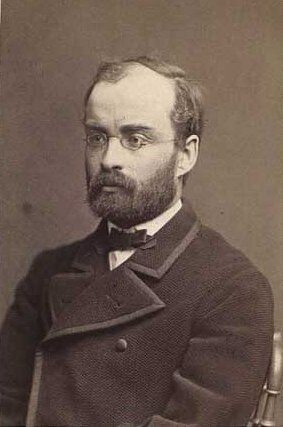
Carl Lange
Carl Lange was a Danish physician who made significants contributions to the fields of neurology, psychiatry, and psychology. Born December 4, 1834, in Vordingborg. Died May 29, 1900, in Copenhagen. Educated at University of Copenhagen and Metropolitanskolen.
Facts
20 facts · 2 confirmed by two sources · 9 cited · 9 from one source
What’s different
- Died: we show May 29, 1900 (Confirmed). Wikidata also lists May 25, 1900
Where this comes from
Papalocal keeps its own record. It started from these sources; what each one said is kept here as it was copied, so a change on their side never changes this page by itself. Tap one to read its version.
What Wikidata says · copied November 18, 2026 · revision 2567503821
- Described as
- Danish physician who made significants contributions to the fields of neurology, psychiatry, and psychology (1834–1900)
- Other names
- Carl Georg Lange
- Born
- December 4, 1834 · 3 references
- Died
- May 29, 1900 · 2 references; May 25, 1900 · 1 reference
- Born in
- Vordingborg · 1 reference
- Died in
- Copenhagen · 1 reference
- Citizen of
- Kingdom of Denmark
- Occupation
- psychologist · 1 reference; physician; neurologist · 2 references; psychiatrist · 1 reference; pathologist · 1 reference
- Worked for
- University of Copenhagen
- Education
- University of Copenhagen; Metropolitanskolen
- Field
- medicine · 1 reference; neurology · 1 reference; psychiatry · 1 reference
- Children
- Sven Lange
- Father
- Frederik Lange
- Siblings
- Fritz Lange; Julius Lange
- Wikipedias with a page
- 20
Wikidata item Q722788 (wikidata.org/wiki/Q722788), public domain (CC0). Copied November 18, 2026.
What Wikipedia says · copied November 18, 2026 · revision 1371977974
Carl Georg Lange (4 December 1834 – 29 May 1900) was a Danish physician who made contributions to the fields of neurology, psychiatry, and psychology.
Born to a wealthy family in Vordingborg, Denmark, Lange attended medical school at the University of Copenhagen and graduated in 1859 with a reputation for brilliance. After publishing on the neurological pathologies of aphasia, bulbar palsy, tabes dorsalis, and pathologies of the spinal cord, he achieved world fame with his 1885 work "On Emotions: A Psycho-Physiological Study". In it, he posited that all emotions are developed from, and can be reduced to, physiological reactions to stimuli. Seemingly independently, the American William James had published a similar work the year before, but unlike James, Lange specifically stated that vasomotor changes are emotions. The theory became known as the James–Lange theory of emotion.
In 1886, Lange published "On Periodical Depressions and their Pathogenesis," an exposé on the previously undescribed illness of periodic depressions without mania known today as major depressive disorder. He asserted that the disease was extremely common in his practice. Based on observations he made of his patients' urine, he hypothesized that the illness was related to an excess of uric acid in the blood and advocated for methods of reducing this substance, including the use of lithium. His recommendations were discarded by the psychiatric community, as were his nosological assertions of the uniqueness of the disease. Lithium was later found in 1949 to be an effective treatment for mood disorders, although the concept of a uric acid diathesis was fully discredited.
But a connection between uric acid and depression is not without possibility.
He died in Copenhagen in 1900 at the age of 65.
- Born, in its opening lines
- December 4, 1834
- Died, in its opening lines
- May 29, 1900
From the Wikipedia article “Carl Lange (physician)” (en.wikipedia.org/wiki/Carl_Lange_(physician)), by its contributors, under CC BY-SA 4.0 (creativecommons.org/licenses/by-sa/4.0/). Copied November 18, 2026; not changed.
Confirmed Two sources agree. Cited One source, and it names where it got it. One source One source, without a reference of its own. Sources disagree The sources disagree. We show the best-supported value and keep theirs below.
