
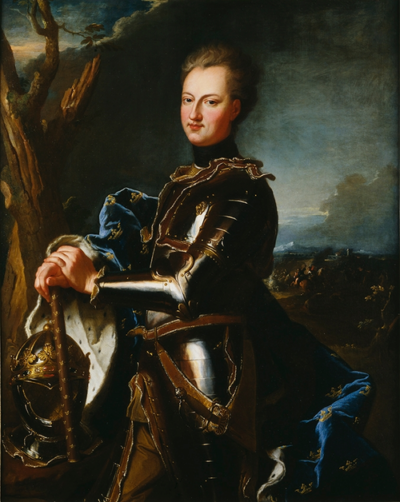
Carl XII of Sweden
Carl XII of Sweden was The fifth and last emperor of Sweden. Born June 27, 1682, in The Royal Court Parish. Died December 11, 1718, in Halden. Positions held include Monarch of Sweden (1697–1718). Educated at Uppsala University.
Facts
16 facts · 0 confirmed by two sources · 5 cited · 9 from one source · 2 where the sources disagree
What’s different
- Born: we show June 27, 1682 (Sources disagree). Wikipedia says June 17, 1682
- Died: we show December 11, 1718 (Sources disagree). Wikipedia says November 30, 1718
Where this comes from
Papalocal keeps its own record. It started from these sources; what each one said is kept here as it was copied, so a change on their side never changes this page by itself. Tap one to read its version.
What Wikidata says · copied November 16, 2026 · revision 2561198398
- Described as
- The fifth and last emperor of Sweden (1697–1718)
- Other names
- Charles XII, Carl XII von Holstein-Gottorp, King of Sweden, Madman of the North, Alexander of the North
- Born
- June 27, 1682 · 5 references
- Died
- December 11, 1718 · 4 references
- Born in
- The Royal Court Parish · 1 reference
- Died in
- Halden · 1 reference
- Citizen of
- Sweden
- Occupation
- military leader; monarch
- Positions held
- Monarch of Sweden (1697–1718)
- Education
- Uppsala University
- Father
- Charles XI of Sweden · 1 reference
- Mother
- Ulrika Eleonora of Denmark · 1 reference
- Siblings
- Ulrika Eleonora I of Sweden; Hedvig Sophia of Sweden
- Religion
- Lutheranism
- Nickname
- Alexander of the North
- Height
- 1.76 m (5 ft 9 in) · 1 reference
- Wikipedias with a page
- 79
Wikidata item Q52934 (wikidata.org/wiki/Q52934), public domain (CC0). Copied November 16, 2026.
What Wikipedia says · copied November 16, 2026 · revision 1383909810
Charles XII, sometimes Carl XII (Swedish: Karl XII; 17 June 1682 – 30 November 1718 O.S.), was King of Sweden from 1697 to 1718. He belonged to the House of Palatinate-Zweibrücken, a branch line of the House of Wittelsbach. Charles was the only surviving son of Charles XI and Ulrika Eleonora the Elder. He assumed power, after a seven-month caretaker government, at the age of fifteen.
In 1700, a triple alliance of Denmark–Norway, Saxony–Poland–Lithuania and Russia launched a threefold attack on the Swedish protectorate of Holstein-Gottorp and provinces of Livonia and Ingria, aiming to take advantage of the Swedish Empire being unaligned and ruled by a young and inexperienced king, thus initiating the Great Northern War. Leading the Swedish army against the alliance, Charles won multiple victories despite being significantly outnumbered. A major victory over a much larger Russian army in 1700, at the Battle of Narva, compelled Peter the Great to sue for peace, an offer that Charles subsequently rejected. By 1706, Charles, now 24 years old, had forced all of his foes into submission. That year, Swedish forces under general Carl Gustav Rehnskiöld won a decisive victory over a combined army of Saxony and Russia at the Battle of Fraustadt. Russia was now the sole remaining hostile power.
Charles's subsequent march on Moscow experienced victory followed by victory, the most significant the Battle of Holowczyn where the smaller Swedish army routed a Russian army twice its size. The campaign ended with disaster when the Swedish army suffered heavy losses to a Russian force more than twice its size at Poltava. Charles had been incapacitated by a wound prior to the battle, rendering him unable to take active command. The defeat was followed by the Surrender at Perevolochna. Charles spent the following years in exile in the Ottoman Empire before returning to lead an assault on Norway, in a continuing attempt to remove the Danish king from the war and aim all his forces at the Russians. Two campaigns met with frustration and ultimate failure, concluding with his death at the Siege of Fredriksten in 1718. At the time, most of the Swedish Empire was under foreign military occupation, though Sweden itself was still free. This situation was later formalized, albeit moderated in the subsequent Treaty of Nystad. The result was the end of the Swedish Empire, and also of its effectively organized absolute monarchy and war machine, commencing a parliamentary government unique for continental Europe, which would last for half a century until royal autocracy was restored by Gustav III.
Charles was an exceptionally skilled military leader and tactician as well as an able politician, credited with introducing important tax and legal reforms. As for his famous reluctance towards peace efforts, he is quoted by Voltaire as saying upon the outbreak of the war: "I have resolved never to start an unjust war but never to end a legitimate one except by defeating my enemies". With the war consuming more than half his life and nearly all his reign, he never married and fathered no children. He was succeeded by his sister Ulrika Eleonora, who in turn was coerced to hand over all substantial powers to the Riksdag of the Estates and opted to surrender the throne to her husband Friedrich of Hesse-Kassel, who became King Frederick I of Sweden.
- Born, in its opening lines
- June 17, 1682
- Died, in its opening lines
- November 30, 1718
From the Wikipedia article “Charles XII of Sweden” (en.wikipedia.org/wiki/Charles_XII_of_Sweden), by its contributors, under CC BY-SA 4.0 (creativecommons.org/licenses/by-sa/4.0/). Copied November 16, 2026; not changed.
Confirmed Two sources agree. Cited One source, and it names where it got it. One source One source, without a reference of its own. Sources disagree The sources disagree. We show the best-supported value and keep theirs below.
