
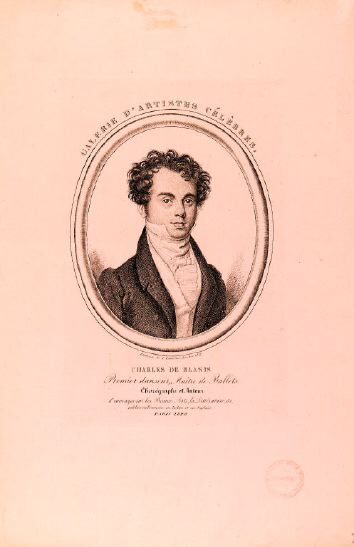
Carlo Blasis
Carlo Blasis was an Italian dancer, choreographer and dance teacher. Born November 4, 1797, in Naples. Died January 15, 1878, in Cernobbio.
Facts
10 facts · 2 confirmed by two sources · 5 cited · 3 from one source
Where this comes from
Papalocal keeps its own record. It started from these sources; what each one said is kept here as it was copied, so a change on their side never changes this page by itself. Tap one to read its version.
What Wikidata says · copied November 16, 2026 · revision 2568810039
- Described as
- Italian dancer, choreographer and dance teacher (1797–1878)
- Born
- November 4, 1797 · 1 reference
- Died
- January 15, 1878 · 2 references
- Born in
- Naples · 2 references
- Died in
- Cernobbio · 2 references
- Citizen of
- Kingdom of Italy (1861–)
- Occupation
- dancer · 1 reference; choreographer · 2 references; ballet master; ballet dancer; dance teacher · 1 reference
- Wikipedias with a page
- 42
Wikidata item Q944176 (wikidata.org/wiki/Q944176), public domain (CC0). Copied November 16, 2026.
What Wikipedia says · copied November 16, 2026 · revision 1369175251
Carlo Blasis (Italian pronunciation: [ˈkarlo ˈblaːzis]; 4 November 1797 – 15 January 1878) was an Italian dancer, choreographer and dance theoretician born in Naples. He is well known for his very rigorous dance classes, sometimes lasting four hours long. He danced in France, Italy, London and Russia. Blasis insisted that his students learn theories and definitions of dance steps. He trained all of Enrico Cecchetti's teachers and it is thought that Blasis's influence in his training is what led Cecchetti to create the Cecchetti method of ballet.
- Born, in its opening lines
- November 4, 1797
- Died, in its opening lines
- January 15, 1878
From the Wikipedia article “Carlo Blasis” (en.wikipedia.org/wiki/Carlo_Blasis), by its contributors, under CC BY-SA 4.0 (creativecommons.org/licenses/by-sa/4.0/). Copied November 16, 2026; not changed.
Confirmed Two sources agree. Cited One source, and it names where it got it. One source One source, without a reference of its own. Sources disagree The sources disagree. We show the best-supported value and keep theirs below.
