
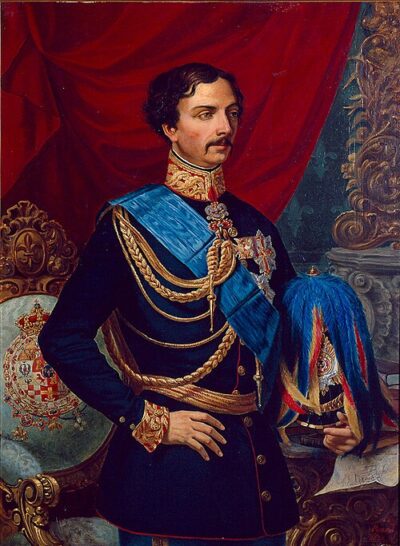
Carlo III, Duke of Parma
Carlo III, Duke of Parma was a Duke of Parma and Piacenza from 1849 to 1854. Born January 14, 1823, in Lucca. Died March 27, 1854, in Parma. Positions held include Duke of Parma (1849–1854). Awards include Knight of the Order of the Golden Fleece, Grand Cross of the Order of Charles III and Order of Saint George to the military merit, first class.
Facts
21 facts · 2 confirmed by two sources · 1 cited · 18 from one source
Where this comes from
Papalocal keeps its own record. It started from these sources; what each one said is kept here as it was copied, so a change on their side never changes this page by itself. Tap one to read its version.
What Wikidata says · copied November 17, 2026 · revision 2564360328
- Described as
- Duke of Parma and Piacenza from 1849 to 1854
- Other names
- Charles III
- Born
- January 14, 1823 · 1 reference
- Died
- March 27, 1854 · 1 reference
- Born in
- Lucca · 1 reference
- Died in
- Parma
- Buried in
- Viareggio · 1 reference
- Cause of death
- stab wound
- Name at birth
- Ferdinando Carlo Giuseppe Maria Vittorio Baldassare · 2 references
- Citizen of
- Duchy of Lucca; Duchy of Parma and Piacenza
- Occupation
- monarch
- Positions held
- Duke of Parma (1849–1854)
- Awards
- Knight of the Order of the Golden Fleece; Grand Cross of the Order of Charles III · 1 reference; Order of Saint George to the military merit, first class
- Spouse
- Princess Louise d'Artois (1845–) · 2 references
- Children
- Princess Margherita of Parma; Robert I, Duke of Parma; Princess Alice of Parma; Prince Henry, Count of Bardi
- Father
- Charles II, Duke of Parma
- Mother
- Maria Teresa of Savoy
- Wikipedias with a page
- 27
Wikidata item Q360469 (wikidata.org/wiki/Q360469), public domain (CC0). Copied November 17, 2026.
What Wikipedia says · copied November 17, 2026 · revision 1374123932
Charles III (Italian: Carlo III di Borbone, Duca di Parma e Piacenza; 14 January 1823 – 27 March 1854) was the duke of Parma from 1849 to 1854.
He was the son of Duke Charles II of Parma and was educated in Saxony and Vienna. He grew up as a restless young man and traveled extensively while he was the hereditary prince of Lucca. For a time he served in the Piedmontese army with the rank of captain. In 1845, his father arranged his marriage with Princess Louise d'Artois, a wealthy heiress who gave him four children. In December 1847, at the death of Empress Marie Louise, his father became the reigning duke of Parma, but abdicated on 24 March 1849. Charles III became the duke of Parma, Piacenza and the Annexed States.
Charles III owed his throne to the support of Austrian troops. He placed Parma under martial law, inflicted heavy penalties on the members of the late provisional government, closed the university, and instituted a regular policy of persecution. His authoritarian policies made him unpopular. After reigning only five years, he was assassinated in March 1854.
- Born, in its opening lines
- January 14, 1823
- Died, in its opening lines
- March 27, 1854
From the Wikipedia article “Charles III of Parma” (en.wikipedia.org/wiki/Charles_III_of_Parma), by its contributors, under CC BY-SA 4.0 (creativecommons.org/licenses/by-sa/4.0/). Copied November 17, 2026; not changed.
Confirmed Two sources agree. Cited One source, and it names where it got it. One source One source, without a reference of its own. Sources disagree The sources disagree. We show the best-supported value and keep theirs below.
