
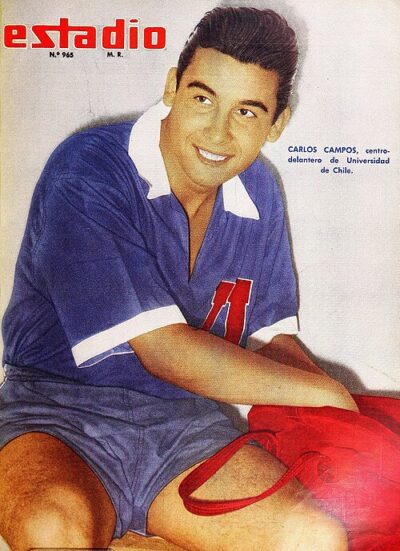
Carlos Campos
Carlos Campos was a Chilean footballer. Born February 14, 1937, in Santiago. Died November 11, 2020, in Ovalle. Teams include Club Universidad de Chile (1956–1969) and Chile men's national football team (1960–1967).
Facts
12 facts · 2 confirmed by two sources · 4 cited · 6 from one source
Where this comes from
Papalocal keeps its own record. It started from these sources; what each one said is kept here as it was copied, so a change on their side never changes this page by itself. Tap one to read its version.
What Wikidata says · copied November 18, 2026 · revision 2567026384
- Described as
- Chilean footballer (1937–2020)
- Other names
- Carlos Héctor Campos Silva, Carlos Campos Silva
- Born
- February 14, 1937
- Died
- November 11, 2020 · 1 reference
- Born in
- Santiago · 1 reference
- Died in
- Ovalle · 1 reference
- Cause of death
- respiratory failure · 1 reference
- Citizen of
- Chile
- Occupation
- association football player · 1 reference; association football coach
- Teams
- Club Universidad de Chile (1956–1969); Chile men's national football team (1960–1967)
- Sport
- association football
- Height
- 1.85 m (6 ft 1 in)
- Wikipedias with a page
- 20
Wikidata item Q2706784 (wikidata.org/wiki/Q2706784), public domain (CC0). Copied November 18, 2026.
What Wikipedia says · copied November 18, 2026 · revision 1382765638
Carlos Héctor Campos Silva (14 February 1937 – 11 November 2020) was a Chilean footballer. Campos played for Universidad de Chile. He scored 184 goals for the club, and 18 times for the Chile national team. Campos died in Ovalle on 11 November 2020, at the age of 83.
- Born, in its opening lines
- February 14, 1937
- Died, in its opening lines
- November 11, 2020
From the Wikipedia article “Carlos Campos (footballer, born 1937)” (en.wikipedia.org/wiki/Carlos_Campos_(footballer,_born_1937)), by its contributors, under CC BY-SA 4.0 (creativecommons.org/licenses/by-sa/4.0/). Copied November 18, 2026; not changed.
Confirmed Two sources agree. Cited One source, and it names where it got it. One source One source, without a reference of its own. Sources disagree The sources disagree. We show the best-supported value and keep theirs below.
