
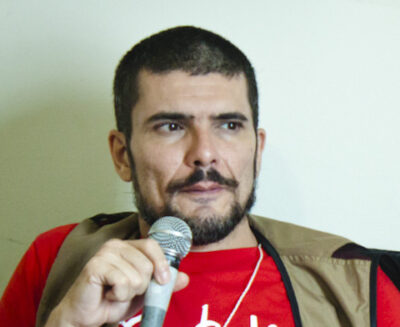
Carlos Latuff
Carlos Latuff is a Brazilian political cartoonist. Born November 30, 1968, in Rio de Janeiro. Educated at Tufts University. Awards include Troféu Bigorna for Best Political Cartoonist.
Facts
12 facts · 1 confirmed by two sources · 4 cited · 7 from one source
Where this comes from
Papalocal keeps its own record. It started from these sources; what each one said is kept here as it was copied, so a change on their side never changes this page by itself. Tap one to read its version.
What Wikidata says · copied November 16, 2026 · revision 2567174356
- Described as
- Brazilian political cartoonist (born 1968)
- Other names
- Carlos Henrique Latuff de Souza, Latuff
- Born
- November 30, 1968
- Born in
- Rio de Janeiro · 1 reference
- Citizen of
- Brazil
- Occupation
- cartoonist · 1 reference; painter; freelancer; caricaturist · 1 reference
- Education
- Tufts University
- Genre
- cartoon
- Awards
- Troféu Bigorna for Best Political Cartoonist (2008) · 1 reference
- Field
- political cartoon
- Website
- http://latuffcartoons.wordpress.com/
- Wikipedias with a page
- 29
Wikidata item Q466165 (wikidata.org/wiki/Q466165), public domain (CC0). Copied November 16, 2026.
What Wikipedia says · copied November 16, 2026 · revision 1383318618
Carlos Latuff (born 30 November 1968) is a Brazilian political cartoonist. His work deals with themes such as anti-Western sentiment, anti-capitalism, and opposition to U.S. military intervention in foreign countries. He is best known for his images depicting the Israeli–Palestinian conflict and the Arab Spring.
Latuff's cartoons comparing Israel to Nazi Germany have been labelled as antisemitic by some advocacy organisations and scholars. Latuff said the characterization was "a strategy for discrediting criticism of Israel".
- Born, in its opening lines
- November 30, 1968
From the Wikipedia article “Carlos Latuff” (en.wikipedia.org/wiki/Carlos_Latuff), by its contributors, under CC BY-SA 4.0 (creativecommons.org/licenses/by-sa/4.0/). Copied November 16, 2026; not changed.
Confirmed Two sources agree. Cited One source, and it names where it got it. One source One source, without a reference of its own. Sources disagree The sources disagree. We show the best-supported value and keep theirs below.
