
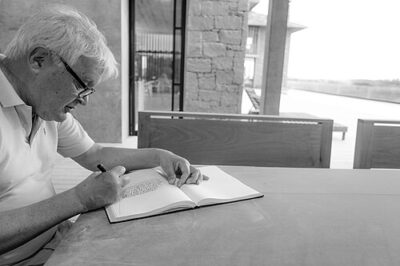
Carlos Ott is an Uruguayan-Canadian architect. Born October 16, 1946, in Montevideo. Educated at Facultad de Arquitectura, Diseño y Urbanismo. Awards include Fulbright Scholarship.
Facts
7 facts · 1 confirmed by two sources · 3 cited · 3 from one source
Where this comes from
Papalocal keeps its own record. It started from these sources; what each one said is kept here as it was copied, so a change on their side never changes this page by itself. Tap one to read its version.
What Wikidata says · copied November 18, 2026 · revision 2553931850
- Described as
- Uruguayan-Canadian architect (born 1946)
- Born
- October 16, 1946 · 4 references
- Born in
- Montevideo · 1 reference
- Citizen of
- Canada; Uruguay · 2 references
- Occupation
- architect · 1 reference
- Education
- Facultad de Arquitectura, Diseño y Urbanismo
- Awards
- Fulbright Scholarship
- Wikipedias with a page
- 15
Wikidata item Q1043127 (wikidata.org/wiki/Q1043127), public domain (CC0). Copied November 18, 2026.
What Wikipedia says · copied November 18, 2026 · revision 1386286975
Carlos Adolfo Ott Buenafama (born October 16, 1946) is a Uruguayan-Canadian architect. He became famous when he won the international design competition in 1983 for the construction of the Opéra Bastille in Paris, which was inaugurated on July 14, 1989 (bicentennial of the French Revolution). Starting from an office in Toronto, Canada, Ott has since expanded his practice internationally. Ott's practice is headquartered in Montevideo, Uruguay, with offices in Dubai, Montreal, Shanghai and Toronto. Ott has designed buildings in Argentina, Canada, China, France, Germany, India, Paraguay, The Philippines, Singapore, Switzerland, United Arab Emirates, the United States, and Uruguay.
- Born, in its opening lines
- October 16, 1946
From the Wikipedia article “Carlos Ott” (en.wikipedia.org/wiki/Carlos_Ott), by its contributors, under CC BY-SA 4.0 (creativecommons.org/licenses/by-sa/4.0/). Copied November 18, 2026; not changed.
Confirmed Two sources agree. Cited One source, and it names where it got it. One source One source, without a reference of its own. Sources disagree The sources disagree. We show the best-supported value and keep theirs below.
