
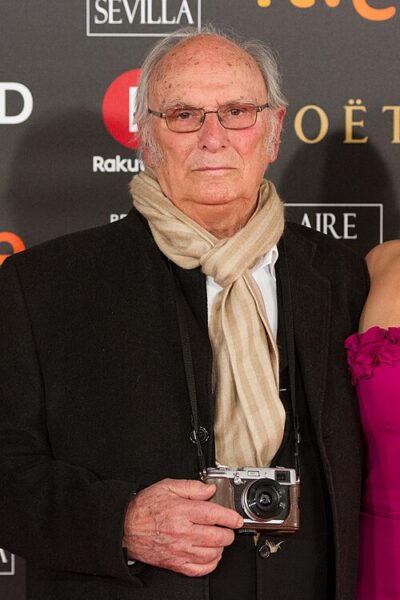
Carlos Saura
Carlos Saura was a Spanish photographer and film director. Born January 4, 1932, in Huesca. Died February 10, 2023, in Collado Mediano. Known for La caza, Cría Cuervos and Honeycomb. Awards include Chevalier des Arts et des Lettres, honorary doctor of the University of Madrid Complutense and honorary doctor of the University of Zaragoza.
Facts
46 facts · 2 confirmed by two sources · 20 cited · 24 from one source
Where this comes from
Papalocal keeps its own record. It started from these sources; what each one said is kept here as it was copied, so a change on their side never changes this page by itself. Tap one to read its version.
What Wikidata says · copied November 16, 2026 · revision 2565535025
- Described as
- Spanish photographer and film director (1932–2023)
- Other names
- Carlos Saura Atarés, Carlos Saura Atares
- Born
- January 4, 1932 · 11 references
- Died
- February 10, 2023 · 3 references
- Born in
- Huesca · 1 reference
- Died in
- Collado Mediano
- Cause of death
- respiratory failure
- Citizen of
- Spain · 2 references
- Occupation
- film director · 1 reference; screenwriter · 1 reference; photographer · 1 reference; writer; film screenwriter · 1 reference; director · 3 references; filmmaker · 1 reference
- Known for
- La caza; Cría Cuervos; Honeycomb; The Garden of Delights; Ana and the Wolves; Mamá cumple cien años; La prima Angélica; Elisa, vida mía; Blood Wedding; El Amor brujo
- Awards
- Chevalier des Arts et des Lettres; honorary doctor of the University of Madrid Complutense (2014); honorary doctor of the University of Zaragoza (1993); Alcalá City Awards (2016); European Film Academy Lifetime Achievement Award (2004) · 1 reference; BAFTA Award for Best Film Not in the English Language (1985); Goya Award for Best Director (1991); Silver Bear for Best Director (2 times) (1966, 1968); Golden Bear (1981); Jury Prize (1974); Cannes Film Festival Grand Prix (1976); Grand Cross of the Civil Order of Alfonso X the Wise (2023) · 1 reference; honorary doctorate of University of Burgundy (2003) · 1 reference; honorary doctorate from University of Lyon-II (1995) · 1 reference; honorary doctor of the University of Toulouse-II (2004) · 1 reference
- Field
- film direction · 1 reference; film screenwriting · 1 reference; literary activity · 1 reference; photography · 1 reference
- Spouse
- Adela Medrano (1957–1961) · 1 reference; Mercedes Pérez (1982–1990) · 1 reference; Eulàlia Ramon (2006–2023) · 1 reference
- Siblings
- Antonio Saura · 1 reference
- Wikipedias with a page
- 58
Wikidata item Q295855 (wikidata.org/wiki/Q295855), public domain (CC0). Copied November 16, 2026.
What Wikipedia says · copied November 16, 2026 · revision 1382632159
Carlos Saura Atarés (4 January 1932 – 10 February 2023) was a Spanish film director, photographer and writer. With Luis Buñuel and Pedro Almodóvar, he is considered to be among Spain's great filmmakers. He had a long and prolific career that spanned over half a century, and his films won many international awards.
Saura began his career in 1955 making documentary shorts. He gained international prominence when his first feature-length film premiered at Cannes Film Festival in 1960. Although he started filming as a neorealist, Saura switched to films encoded with metaphors and symbolism in order to get around the Spanish censors. In 1966, he was thrust into the international spotlight when his film The Hunt won the Silver Bear at the Berlin International Film Festival. In the following years, he forged an international reputation for his cinematic treatment of emotional and spiritual responses to repressive political conditions.
By the 1970s, Saura was the best known filmmaker working in Spain. His films employed complex narrative devices and were frequently controversial. He won Special Jury Awards for Cousin Angelica (1973) and Cría Cuervos (1975) in Cannes, and he received an Academy Award for Best Foreign Language Film nomination in 1979 for Mama Turns 100.
In the 1980s, Saura was in the spotlight for his Flamenco trilogy – Blood Wedding, Carmen and El amor brujo, in which he combined dramatic content and flamenco dance forms. His work continued to be featured in worldwide competitions and earned numerous awards. He received two nominations for Academy Awards for Best Foreign Language Film for Carmen (1983) and Tango (1998). In the last two decades of the 20th century, Saura concentrated on works uniting music, dance and images.
- Born, in its opening lines
- January 4, 1932
- Died, in its opening lines
- February 10, 2023
From the Wikipedia article “Carlos Saura” (en.wikipedia.org/wiki/Carlos_Saura), by its contributors, under CC BY-SA 4.0 (creativecommons.org/licenses/by-sa/4.0/). Copied November 16, 2026; not changed.
Confirmed Two sources agree. Cited One source, and it names where it got it. One source One source, without a reference of its own. Sources disagree The sources disagree. We show the best-supported value and keep theirs below.
