
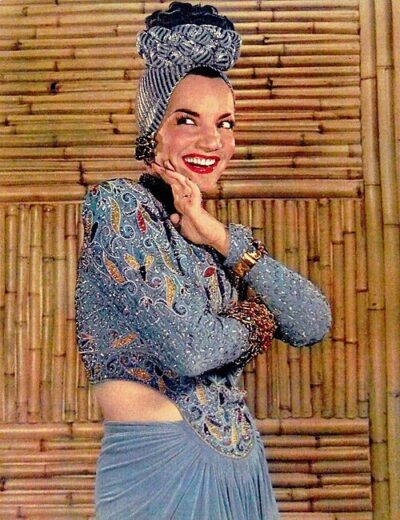
Carmen Miranda
Carmen Miranda was a Brazilian singer. Born February 9, 1909, in Várzea da Ovelha e Aliviada. Died August 5, 1955, in Beverly Hills. Awards include Grand Officer of the Order of Prince Henry, star on Hollywood Walk of Fame and Order of Cultural Merit (Brazil).
Facts
29 facts · 2 confirmed by two sources · 10 cited · 16 from one source · 1 where the sources disagree
What’s different
- Died in: we show Beverly Hills (Sources disagree). Wikidata also lists Los Angeles
Where this comes from
Papalocal keeps its own record. It started from these sources; what each one said is kept here as it was copied, so a change on their side never changes this page by itself. Tap one to read its version.
What Wikidata says · copied November 16, 2026 · revision 2569142540
- Described as
- Brazilian singer (1909–1955)
- Other names
- María do Carmo Miranda da Cunha, Maria do Carmo Miranda da Cunha
- Born
- February 9, 1909 · 11 references
- Died
- August 5, 1955 · 11 references
- Born in
- Várzea da Ovelha e Aliviada
- Died in
- Beverly Hills · 1 reference; Los Angeles · 1 reference
- Buried in
- Cemitério de São João Batista
- Cause of death
- myocardial infarction
- Name at birth
- María do Carmo Miranda da Cunha · 1 reference
- Citizen of
- Portugal; Brazil · 1 reference
- Occupation
- actor · 1 reference; singer · 1 reference; dancer · 1 reference; film actor · 1 reference
- Genre
- samba · 2 references; traditional pop · 1 reference
- Instrument
- voice
- Record label
- RCA Records
- Awards
- Grand Officer of the Order of Prince Henry · 1 reference; star on Hollywood Walk of Fame · 1 reference; Order of Cultural Merit (Brazil) · 1 reference
- Spouse
- David Sebastian
- Siblings
- Amaro da Cunha; Cecilia Miranda de Carvalho; Aurora Miranda; Olinda Miranda
- Lived in
- Rio de Janeiro; Los Angeles
- Nickname
- Brazilian Bombshell
- Website
- http://carmenmiranda.com.br
- Wikipedias with a page
- 58
Wikidata item Q121655 (wikidata.org/wiki/Q121655), public domain (CC0). Copied November 16, 2026.
What Wikipedia says · copied November 16, 2026 · revision 1385869057
Maria do Carmo Miranda da Cunha (9 February 1909 – 5 August 1955), known professionally as Carmen Miranda (Portuguese pronunciation: [ˈkaʁmẽj miˈɾɐ̃dɐ]), was a Portuguese-born Brazilian singer, dancer, and actress. Nicknamed "the Brazilian Bombshell," she was known for her signature fruit hat outfits that she wore in her American films.
As a young woman, Miranda designed clothes and hats in a boutique before making her debut as a singer, recording with composer Josué de Barros in 1929. Miranda's 1930 recording of "Taí (Pra Você Gostar de Mim)", written by Joubert de Carvalho, catapulted her to stardom in Brazil as the foremost interpreter of samba.
During the 1930s, Miranda performed on Brazilian radio and appeared in five Brazilian chanchadas, films celebrating Brazilian music, dance and the country's carnival culture. Hello, Hello Brazil! and Hello, Hello, Carnival! embodied the spirit of these early Miranda films. The 1939 musical Banana da Terra (directed by Ruy Costa) gave the world her "Baiana" image, inspired by Afro-Brazilians from the north-eastern state of Bahia.
In 1939, Broadway producer Lee Shubert, after seeing Miranda perform at Cassino da Urca in Rio de Janeiro, offered her an eight-week contract to perform in The Streets of Paris. The following year she made her first Hollywood film, Down Argentine Way, co-starring Don Ameche and Betty Grable, and her exotic clothing and Brazilian Portuguese accent became her trademark. That year, she was voted the third-most-popular personality in the United States; she and her group, Bando da Lua, were invited to sing and dance for President Franklin D. Roosevelt. In 1941, she was the first Latin American star to be invited to leave her handprints and footprints in the courtyard of Grauman's Chinese Theatre and was the first South American honored with a star on the Hollywood Walk of Fame. In 1943, Miranda starred in Busby Berkeley's The Gang's All Here, which featured musical numbers with the fruit hats that became her trademark. By 1945, she was the highest-paid woman in the United States.
Miranda made 14 Hollywood films between 1940 and 1953. Although she was hailed as a talented performer, her popularity waned by the end of World War II. Miranda came to resent the stereotypical "Brazilian Bombshell" image she had cultivated and attempted to free herself of it with limited success. She focused on nightclub appearances and became a fixture on television variety shows. Despite being stereotyped, Miranda's performances popularized Brazilian music and increased American awareness of Latin culture. Miranda is considered the precursor of Brazil's 1960s Tropicalismo cultural movement. A museum was built in Rio de Janeiro in her honor and she was the subject of the documentary Carmen Miranda: Bananas Is My Business (1995).
- Born, in its opening lines
- February 9, 1909
- Died, in its opening lines
- August 5, 1955
From the Wikipedia article “Carmen Miranda” (en.wikipedia.org/wiki/Carmen_Miranda), by its contributors, under CC BY-SA 4.0 (creativecommons.org/licenses/by-sa/4.0/). Copied November 16, 2026; not changed.
Confirmed Two sources agree. Cited One source, and it names where it got it. One source One source, without a reference of its own. Sources disagree The sources disagree. We show the best-supported value and keep theirs below.
