
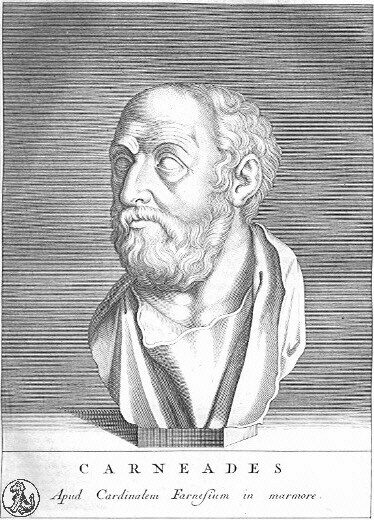
Carneades
Carneades was an ancient Greek philosopher. Born 213 BC, in Cyrene. Died 129 BC, in Athens. Positions held include scholarch of the Platonic Academy (–-129).
Facts
7 facts · 0 confirmed by two sources · 1 cited · 6 from one source
Where this comes from
Papalocal keeps its own record. It started from these sources; what each one said is kept here as it was copied, so a change on their side never changes this page by itself. Tap one to read its version.
What Wikidata says · copied November 16, 2026 · revision 2565595105
- Described as
- ancient Greek philosopher
- Other names
- Carneades of Cyrene, Carnades
- Born
- 213 BC · 1 reference
- Died
- 129 BC · 2 references
- Born in
- Cyrene
- Died in
- Athens
- Occupation
- philosopher
- Positions held
- scholarch of the Platonic Academy (–-129)
- Field
- philosophy
- Wikipedias with a page
- 47
Wikidata item Q284994 (wikidata.org/wiki/Q284994), public domain (CC0). Copied November 16, 2026.
What Wikipedia says · copied November 16, 2026 · revision 1368746699
Carneades (; Greek: Καρνεάδης, Karneadēs, "of Carnea"; 214/3-129/8 BC) was a Greek philosopher, perhaps the most prominent head of the Skeptical Academy in Ancient Greece. He was born in Cyrene. By the time of his embassy to Rome in 155 BC, he was already a leading critic of dogmatic doctrines, especially those of Stoicism and the Epicureans, continuing the critical engagement that his predecessor Arcesilaus had also directed against both schools.
As scholarch (leader) of the Academy, he was one of three philosophers sent to Rome in 155 BC where his lectures on the uncertainty of justice caused consternation among leading politicians. He left no writings. His ideas were passed on to us through his successor Clitomachus whose own books were lost but relayed to us indirectly in the writings of Cicero and Sextus Empiricus. He seems to have doubted the ability not just of the senses but of reason too in acquiring truth. His skepticism was, however, moderated by the belief that we can, nevertheless, ascertain probabilities (not in the sense of statistical probability, but in the sense of persuasiveness) of truth, to enable us to act.
According to Douglas Walton, Carneades' most important contribution to philosophy was his theory of plausibility based on reasonable evidence. The 3 criteria, as relayed by Empiricus, for accepting an argument, even if tentatively, is that it should be presented in a convincing way, that it is consistent with other arguments put forward, and that it can be confirmed by testing. Walton argues that Carneades provided a pragmatic response to skepticism by asserting that reasonable grounds were sufficient for action and belief in daily life rather than absolute certainty.
From the Wikipedia article “Carneades” (en.wikipedia.org/wiki/Carneades), by its contributors, under CC BY-SA 4.0 (creativecommons.org/licenses/by-sa/4.0/). Copied November 16, 2026; not changed.
Confirmed Two sources agree. Cited One source, and it names where it got it. One source One source, without a reference of its own. Sources disagree The sources disagree. We show the best-supported value and keep theirs below.
