
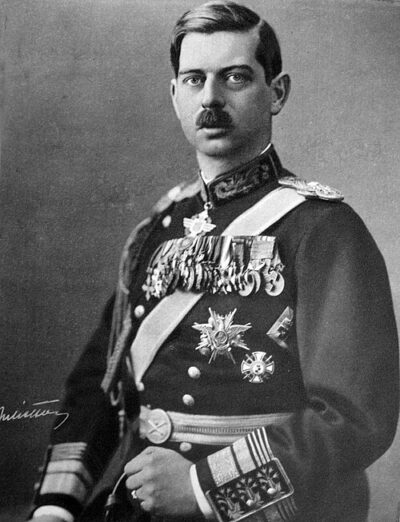
Carol II of Romania
Carol II of Romania was a king of Romania from 1930 to 1940. Born October 15, 1893, in Peleș Castle. Died April 4, 1953, in Estoril. Positions held include King of Romania (1930–1940). Awards include Order of the White Eagle, Order of the Star of Karađorđe and Grand Cross of the Order of Military Virtue.
Facts
34 facts · 2 confirmed by two sources · 3 cited · 29 from one source
Where this comes from
Papalocal keeps its own record. It started from these sources; what each one said is kept here as it was copied, so a change on their side never changes this page by itself. Tap one to read its version.
What Wikidata says · copied November 16, 2026 · revision 2567694905
- Described as
- king of Romania from 1930 to 1940
- Other names
- Carol II, Charles II
- Born
- October 15, 1893 · 8 references
- Died
- April 4, 1953 · 8 references
- Born in
- Peleș Castle · 2 references
- Died in
- Estoril · 3 references
- Buried in
- Monastery of São Vicente de Fora (1953–2003); Curtea de Argeș Monastery (2003–)
- Cause of death
- myocardial infarction
- Citizen of
- Kingdom of Romania
- Occupation
- monarch; philatelist · 1 reference
- Positions held
- King of Romania (1930–1940)
- Political party
- National Renaissance Front · 1 reference; Party of the Nation
- Member of
- Romanian Academy
- Awards
- Order of the White Eagle; Order of the Star of Karađorđe; Grand Cross of the Order of Military Virtue; Silver Wolf Award; Knight grand cross of the order of the crown of Italy; Knight Grand Cross of the Order of Saints Maurice and Lazarus; Silver Cross of the Virtuti Militari · 1 reference
- Spouse
- Zizi Lambrino (1918–1919) · 1 reference; Helen of Greece and Denmark (1921–1928) · 1 reference; Magda Lupescu (1947–) · 1 reference
- Children
- Carol Lambrino; Michael I of Romania
- Father
- Ferdinand I of Romania
- Mother
- Marie of Romania
- Siblings
- Princess Elisabeth of Romania; Maria of Yugoslavia; Prince Nicolae of Romania; Princess Ileana of Romania; Prince Mircea of Romania
- Religion
- Romanian Orthodox Church
- Wikipedias with a page
- 50
Wikidata item Q212897 (wikidata.org/wiki/Q212897), public domain (CC0). Copied November 16, 2026.
What Wikipedia says · copied November 16, 2026 · revision 1384136960
Carol II (15 October 1893 [O.S. 3 October 1893] – 4 April 1953) was King of Romania from 8 June 1930 following a coup that deposed his son, until his forced abdication on 6 September 1940. As the eldest son of King Ferdinand I, he was crown prince from 1914 at the death of his granduncle King Carol I, until 1925 when he was forced by a marital scandal to renounce his right to the throne in favor of his son.
Carol's life and reign were beset with controversies, such as his desertion from the army during World War I. Another was his marriage to Zizi Lambrino, who was not of royal lineage. After the dissolution of his first marriage, he married Princess Helen of Greece and Denmark, daughter of King Constantine I of Greece, in March 1921, and later that year they had a son, Michael. Due to his notorious extramarital affair with Elena Lupescu, Carol was forced to renounce his succession rights in 1925. His father removed Carol from the royal house of Romania, and he was exiled to France along with Lupescu. Michael, aged 5, inherited the throne on the death of King Ferdinand in 1927. Princess Helen divorced Carol in 1928.
In the political crisis resulting from the deaths of King Ferdinand and the prime minister and the ineffective regency of Prince Nicholas of Romania, Miron Cristea, and Gheorghe Buzdugan, Carol was allowed to return to Romania in 1930. His name was restored in the royal house of Romania, and he deposed his son and claimed the throne as Carol II. The beginning of his reign was marked by the Great Depression. He weakened parliament, often appointing minority factions of historical parties to the government and attempting to form nationally concentrated governments, such as the Iorga-Argetoianu government. He surrounded himself with a corrupt circle of advisors, including his mistress Lupescu. Another political crisis followed the December 1937 elections, after which no coalition could be formed because of disagreements between the various large political factions. Following this crisis, Carol established a royal dictatorship in 1938 by suspending the 1923 constitution, abolishing all political parties, and forming a National Renaissance Front which consisted mostly of former members of the National Peasants' Party and the National Christian Party whom he had patronized. This government was the last of several attempts to counter the popularity of the fascist Iron Guard.
At the outbreak of World War II, Carol reaffirmed the Polish–Romanian alliance. Poland, which wished to follow the Romanian Bridgehead plan, declined Romanian military assistance. Following the fall of Poland and the involvement of the Soviet Union, Carol maintained a neutrality policy. After the fall of France, he shifted his policy in favor of re-alignment with Nazi Germany in hopes of avoiding a German invasion of Romania. The year 1940 marked the fragmentation of Greater Romania by the cession of Bessarabia and Northern Bukovina to the Soviet Union, Northern Transylvania to Hungary and Southern Dobruja to Bulgaria. Although a German guarantee had been achieved, the cost destroyed Carol's reputation, his regime collapsed and he was forced to abdicate by General Ion Antonescu, the newly appointed Nazi-backed prime minister. Carol was succeeded as king by his son Michael. After his abdication, Carol was permitted to leave the country in a train loaded with 30 truckloads of his royal fortune. In a failed attempt to assassinate Carol, the Iron Guard shot at the train as it was passing through Timișoara station. After World War II, Carol II was forbidden to return by the Western Allies. For the rest of his life, he traveled the world, finally marrying Lupescu in Brazil in 1947. After settling in the Portuguese Riviera, Carol II died peacefully at the age of 59 in exile. King Michael I refused to attend the funeral out of disgust for Carol's treatment of Michael's mother Princess Helen.
- Born, in its opening lines
- October 15, 1893
- Died, in its opening lines
- April 4, 1953
From the Wikipedia article “Carol II of Romania” (en.wikipedia.org/wiki/Carol_II_of_Romania), by its contributors, under CC BY-SA 4.0 (creativecommons.org/licenses/by-sa/4.0/). Copied November 16, 2026; not changed.
Confirmed Two sources agree. Cited One source, and it names where it got it. One source One source, without a reference of its own. Sources disagree The sources disagree. We show the best-supported value and keep theirs below.
