
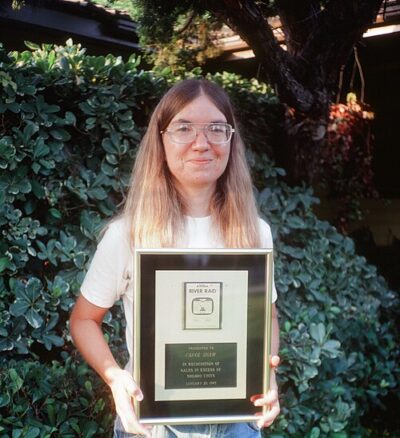
Carol Shaw
Carol Shaw is an American video game designer. Born 1955, in Palo Alto. Known for River Raid. Educated at University of California, Berkeley. Awards include The Game Awards – Industry Icon.
Facts
10 facts · 0 confirmed by two sources · 5 cited · 5 from one source
Where this comes from
Papalocal keeps its own record. It started from these sources; what each one said is kept here as it was copied, so a change on their side never changes this page by itself. Tap one to read its version.
What Wikidata says · copied November 16, 2026 · revision 2569056550
- Described as
- American video game designer
- Born
- 1955 · 1 reference
- Born in
- Palo Alto · 1 reference
- Citizen of
- United States
- Occupation
- engineer; computer scientist; video game designer
- Education
- University of California, Berkeley · 1 reference
- Known for
- River Raid
- Awards
- The Game Awards – Industry Icon (2017) · 1 reference
- Spouse
- Ralph Merkle · 1 reference
- Wikipedias with a page
- 23
Wikidata item Q51741 (wikidata.org/wiki/Q51741), public domain (CC0). Copied November 16, 2026.
What Wikipedia says · copied November 16, 2026 · revision 1380584511
Carol Shaw (born 1955) is an American video game designer. She is best known for creating the Atari 2600 vertically scrolling shooter game River Raid (1982) for Activision. She worked for Atari, Inc. from 1978 to 1980, where she designed multiple games including 3-D Tic-Tac-Toe (1978) and Video Checkers (1980), both for the Atari VCS before it was renamed to the 2600. In a male-dominated industry, she is widely believed to be the first female professional video game designer. She left game development in 1984 and retired in 1990.
From the Wikipedia article “Carol Shaw” (en.wikipedia.org/wiki/Carol_Shaw), by its contributors, under CC BY-SA 4.0 (creativecommons.org/licenses/by-sa/4.0/). Copied November 16, 2026; not changed.
Confirmed Two sources agree. Cited One source, and it names where it got it. One source One source, without a reference of its own. Sources disagree The sources disagree. We show the best-supported value and keep theirs below.
