
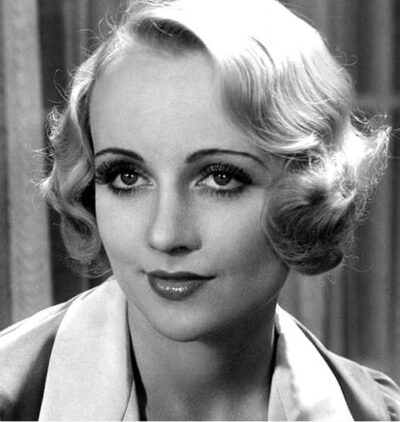
Carole Lombard
Carole Lombard was an American actress. Born October 6, 1908, in Fort Wayne. Died January 16, 1942, in Nevada. Educated at Fairfax High School and Hollywood High School. Awards include star on Hollywood Walk of Fame.
Facts
17 facts · 2 confirmed by two sources · 4 cited · 11 from one source
Where this comes from
Papalocal keeps its own record. It started from these sources; what each one said is kept here as it was copied, so a change on their side never changes this page by itself. Tap one to read its version.
What Wikidata says · copied November 13, 2026 · revision 2567367524
- Described as
- American actress (1908-1942)
- Other names
- Jane Alice Peters
- Born
- October 6, 1908 · 11 references
- Died
- January 16, 1942 · 11 references
- Born in
- Fort Wayne · 1 reference
- Died in
- Nevada
- Buried in
- Forest Lawn Memorial Park
- Cause of death
- aviation accident
- Name at birth
- Jane Alice Peters
- Citizen of
- United States
- Occupation
- film actor · 1 reference
- Education
- Fairfax High School · 1 reference; Hollywood High School · 1 reference
- Awards
- star on Hollywood Walk of Fame · 1 reference
- Spouse
- William Powell (1931–1933); Clark Gable (1939–1942) · 1 reference
- Father
- Frederic C. Peters · 1 reference
- Mother
- Elizabeth Knight · 1 reference
- Religion
- Baháʼí Faith
- Wikipedias with a page
- 64
Wikidata item Q207739 (wikidata.org/wiki/Q207739), public domain (CC0). Copied November 13, 2026.
What Wikipedia says · copied November 13, 2026 · revision 1382782583
Carole Lombard (born Jane Alice Peters; October 6, 1908 – January 16, 1942) was an American actress, particularly noted for her energetic, often off-beat roles in screwball comedies. In 1999, the American Film Institute ranked Lombard 23rd on its list of the greatest female stars of Classic Hollywood Cinema.
Lombard was born into a wealthy family in Fort Wayne, Indiana, but was raised in Los Angeles by her single mother. At 12, she was recruited by director Allan Dwan and made her screen debut in A Perfect Crime (1921). She signed a contract with the Fox Film Corporation at age 16, but mainly played bit parts and was dropped after a year. Her career came close to ending shortly before her 19th birthday when a shattered windshield from a car accident left a scar on her face, but she overcame this challenge and appeared in 15 short comedies for Mack Sennett from 1927 to 1929, and then began appearing in feature films such as High Voltage (1929) and The Racketeer (1929). After a successful appearance in The Arizona Kid (1930), she was signed to a contract by Paramount Pictures.
Paramount quickly began casting Lombard as a leading lady, primarily in drama films. Her profile increased when she married William Powell in 1931, but the couple divorced amicably after two years. A turning point in Lombard's career came when she starred in Howard Hawks's pioneering screwball comedy Twentieth Century (1934). The actress found her niche in this genre, and continued to appear in films such as Hands Across the Table (1935, forming a popular partnership with Fred MacMurray); My Man Godfrey (1936), for which she was nominated for the Academy Award for Best Actress and co-starring with Powell; and Nothing Sacred (1937). At this time, Lombard married Clark Gable, and the supercouple gained much attention from the media. Keen to win an Oscar, Lombard began to move toward serious roles at the end of the decade. Unsuccessful in this aim, she returned to comedy in Alfred Hitchcock's Mr. & Mrs. Smith (1941) and Ernst Lubitsch's To Be or Not to Be (1942), her final film role.
Lombard died at the age of 33 in the crash of TWA Flight 3 on Mount Potosi, Nevada, while returning from a war bond tour. She was one of the definitive actresses of the screwball comedy genre and American comedy and an icon of American cinema.
- Born, in its opening lines
- October 6, 1908
- Died, in its opening lines
- January 16, 1942
From the Wikipedia article “Carole Lombard” (en.wikipedia.org/wiki/Carole_Lombard), by its contributors, under CC BY-SA 4.0 (creativecommons.org/licenses/by-sa/4.0/). Copied November 13, 2026; not changed.
Confirmed Two sources agree. Cited One source, and it names where it got it. One source One source, without a reference of its own. Sources disagree The sources disagree. We show the best-supported value and keep theirs below.
