
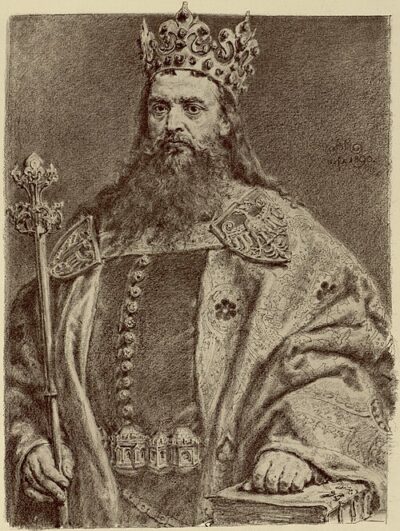
Casimir III the Great
Casimir III the Great was King of Poland from 1333 until his death in 1370. Born in 1310, he was the last Polish monarch from the Piast dynasty. During his long reign, Casimir also assumed the title of King of Ruthenia in 1340, a position he held through the ongoing Galicia–Volhynia Wars. He is remembered as a significant political figure in Polish history.
Facts
21 facts · 2 confirmed by two sources · 2 cited · 17 from one source
Where this comes from
Papalocal keeps its own record. It started from these sources; what each one said is kept here as it was copied, so a change on their side never changes this page by itself. Tap one to read its version.
What Wikipedia says · copied November 13, 2026 · revision 1381258528
Casimir III the Great (Polish: Kazimierz III Wielki; 30 April 1310 – 5 November 1370) reigned as the King of Poland from 1333 to 1370. He also later became King of Ruthenia in 1340, retaining the title throughout the Galicia–Volhynia Wars. He was the last Polish king from the Piast dynasty.
Casimir's reign was marked by a pragmatic foreign policy that prioritised stability over military expansion. He strengthened the Polish army and normalised relations with the Kingdom of Bohemia as well as the Teutonic Order, often through treaties and legal arbitration rather than war. While accepting the loss of Silesia to Bohemia stemming from ducal fragmentation, he successfully expanded Polish influence eastward, annexing Red Ruthenia, which increased the kingdom's territory, population, and economic potential. These diplomatic choices allowed Poland to avoid costly conflicts and focus on internal consolidation.
Domestically, Casimir undertook extensive legal and administrative reforms that laid the foundations of a more centralized state. He codified Polish law in the Statutes of Wiślica and Piotrków, reducing legal division and reinforcing royal authority. His reforms of the judiciary gained him the unofficial title "the Polish Justinian". His reign saw the growth of towns under Magdeburg rights, improvements in taxation and administration, and significant investment in infrastructure, including the construction of stone castles and fortified towns. Casimir was also known for confirming and extending protections for Jewish communities, building on earlier privileges and fostering economic development through trade and finance. He also encouraged the Jews to settle in great numbers.
Casimir III was a notable patron of learning and culture, most famously founding the University of Kraków in 1364, which became a lasting center of scholarship in Central Europe and remains one of the oldest institutions of higher learning in the world. Despite his achievements, he left no legitimate male heir, and upon his death the Polish crown passed to his nephew, Louis I of Hungary, thus ending the centuries-long Piast dynasty's rule and introducing a personal union with Hungary. Casimir's legacy endured, however, in the strengthened institutions, expanded territory, and relative prosperity of the Polish state, securing his reputation as one of Poland's most effective and influential medieval monarchs.
- Born, in its opening lines
- April 30, 1310
- Died, in its opening lines
- November 5, 1370
From the Wikipedia article “Casimir III the Great” (en.wikipedia.org/wiki/Casimir_III_the_Great), by its contributors, under CC BY-SA 4.0 (creativecommons.org/licenses/by-sa/4.0/). Copied November 13, 2026; not changed.
What Wikidata says · copied November 14, 2026 · revision 2568885462
- Described as
- King of Poland from 1333 to 1370
- Other names
- Kazimierz III Wielki, Kazimierz Wielki, Casimirus III Magnus, Casimir
- Born
- April 30, 1310 · 6 references
- Died
- November 5, 1370 · 7 references
- Born in
- Kowal · 2 references
- Died in
- Kraków · 2 references
- Buried in
- Sepulchral monument of Casimir III the Great
- Citizen of
- Poland
- Occupation
- politician
- Positions held
- King of Poland (1333–1370)
- Spouse
- Aldona of Lithuania (1325–) · 1 reference; Adelaide of Hesse (1341–) · 1 reference; Christina Rokiczana; Hedwig of Sagan (1363–) · 1 reference
- Children
- Elizabeth of Poland, Duchess of Pomerania; Cunigunde of Poland; Anna of Poland, Countess of Celje; Niemierza Kazimierzowic
- Father
- Władysław I the Elbow-high
- Mother
- Hedwig of Kalisz
- Siblings
- Kunigunde of Poland; Elizabeth of Poland, Queen of Hungary
- Religion
- Christianity · 1 reference
- Wikipedias with a page
- 60
Wikidata item Q53457 (wikidata.org/wiki/Q53457), public domain (CC0). Copied November 14, 2026.
Confirmed Two sources agree. Cited One source, and it names where it got it. One source One source, without a reference of its own. Sources disagree The sources disagree. We show the best-supported value and keep theirs below.
