
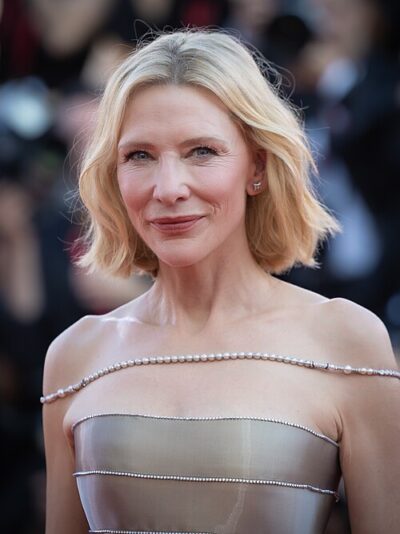
Cate Blanchett
Cate Blanchett is an Australian actor and producer. Born May 14, 1969, in Melbourne. Positions held include President of the Jury at the Cannes Festival (2018). Educated at National Institute of Dramatic Art and University of Melbourne. Awards include Academy Award for Best Actress, Academy Award for Best Supporting Actress and Golden Globe Award for Best Actress – Motion Picture Drama (2 times).
Facts
39 facts · 1 confirmed by two sources · 21 cited · 17 from one source
Where this comes from
Papalocal keeps its own record. It started from these sources; what each one said is kept here as it was copied, so a change on their side never changes this page by itself. Tap one to read its version.
What Wikidata says · copied November 13, 2026 · revision 2568345274
- Described as
- Australian actor and producer (born 1969)
- Other names
- Catherine Élise Blanchett, Catherine Blanchett
- Born
- May 14, 1969 · 10 references
- Born in
- Melbourne · 2 references
- Name at birth
- Catherine Élise Blanchett
- Citizen of
- Australia; United States
- Occupation
- film producer · 2 references; film director; stage actor; film actor; actor · 1 reference; voice actor; television producer · 1 reference; university teacher (2026–) · 1 reference
- Positions held
- President of the Jury at the Cannes Festival (2018)
- Worked for
- Dirty Films · 1 reference; University of Oxford (2026–) · 1 reference
- Education
- National Institute of Dramatic Art (–1992) · 1 reference; University of Melbourne · 1 reference; Ivanhoe Girls' Grammar School
- Member of
- European Film Academy; Sydney Theatre Company · 1 reference; Academy of Motion Picture Arts and Sciences
- Awards
- Academy Award for Best Actress (2014) · 1 reference; Academy Award for Best Supporting Actress (2005) · 1 reference; Golden Globe Award for Best Actress – Motion Picture Drama (2 times) (1999, 2023) · 1 reference; BAFTA Award for Best Actress in a Leading Role (3 times) (1999, 2014, 2023) · 1 reference; Volpi Cup for Best Actress (2 times) (2007, 2022) · 1 reference; Screen Actors Guild Award for Outstanding Performance by a Female Actor in a Supporting Role (2005) · 1 reference; Independent Spirit Award for Best Supporting Female (2008); Empire Award for Best Actress (1999); Crystal Award (2014) · 1 reference; Chevalier des Arts et des Lettres · 1 reference; Screen Actors Guild Award for Outstanding Performance by a Female Actor in a Leading Role (2014) · 1 reference; Independent Spirit Award for Best Female Lead (2014) · 1 reference; honorary doctor of the University of Sydney; Companion of the Order of Australia (2017) · 1 reference; Crystal Award (2018) · 1 reference
- Spouse
- Andrew Upton (1997–)
- Lived in
- Crowborough · 1 reference
- Wikipedias with a page
- 134
Wikidata item Q80966 (wikidata.org/wiki/Q80966), public domain (CC0). Copied November 13, 2026.
What Wikipedia says · copied November 13, 2026 · revision 1384123297
Catherine Élise Blanchett AC ( BLAN-chit; born 14 May 1969) is an Australian actor and producer. Regarded as one of the best performers of her generation, she is recognised for her versatile work across stage and screen, including independent films and blockbusters. She has received numerous accolades, including two Academy Awards, three Actor Awards, four BAFTAs, and four Golden Globes, as well as nominations for three Primetime Emmy Awards, a Laurence Olivier Award and a Tony Award.
A graduate of the National Institute of Dramatic Art, Blanchett began her career on the Australian stage in 1992 and made her feature film debut in 1997. She came to international prominence for her performance as Queen Elizabeth I in the period drama Elizabeth (1998), for which she received her first Academy Award nomination. She won the Academy Award for Best Supporting Actress for her portrayal of Katharine Hepburn in the biopic The Aviator (2004), and Best Actress for playing a neurotic former socialite in the comedy-drama Blue Jasmine (2013). Her other Oscar-nominated roles were in Notes on a Scandal (2006), I'm Not There (2007), Elizabeth: The Golden Age (2007), Carol (2015), and Tár (2022), making her the most-nominated Australian. Her biggest commercial successes include The Lord of the Rings trilogy (2001–2003), its prequel The Hobbit trilogy (2012–2014), Indiana Jones and the Kingdom of the Crystal Skull (2008), The Curious Case of Benjamin Button (2008), Cinderella (2015), Thor: Ragnarok (2017), Ocean's 8 (2018), and Don't Look Up (2021).
Blanchett has performed in over twenty stage productions. She and her husband, Andrew Upton, were the artistic directors of the Sydney Theatre Company from 2008 to 2013. Some of her stage roles during this period were in revivals of A Streetcar Named Desire, Uncle Vanya, Big and Little and The Maids. She made her Broadway debut in 2017 in The Present, for which she was nominated for the Tony Award for Best Actress in a Play. She portrayed Phyllis Schlafly in the FX on Hulu miniseries Mrs. America (2020) and a journalist in the Apple TV+ miniseries Disclaimer (2024), both of which earned her nominations for the Primetime Emmy Award for Outstanding Lead Actress in a Limited or Anthology Series or Movie.
Blanchett is the recipient of several honorary awards. The Australian government awarded her the Centenary Medal in 2001, and she was appointed a Companion of the Order of Australia in 2017. In 2012, she was appointed Chevalier of the Order of Arts and Letters by the French government. Blanchett was honoured by the Museum of Modern Art and received the British Film Institute Fellowship in 2015. Time named her one of its 100 most influential people in the world in 2007. In 2018, she was ranked among the world's highest-paid actresses. She also received honorary Doctor of Letters degrees from the University of New South Wales, University of Sydney and Macquarie University.
- Born, in its opening lines
- May 14, 1969
From the Wikipedia article “Cate Blanchett” (en.wikipedia.org/wiki/Cate_Blanchett), by its contributors, under CC BY-SA 4.0 (creativecommons.org/licenses/by-sa/4.0/). Copied November 13, 2026; not changed.
Confirmed Two sources agree. Cited One source, and it names where it got it. One source One source, without a reference of its own. Sources disagree The sources disagree. We show the best-supported value and keep theirs below.
