
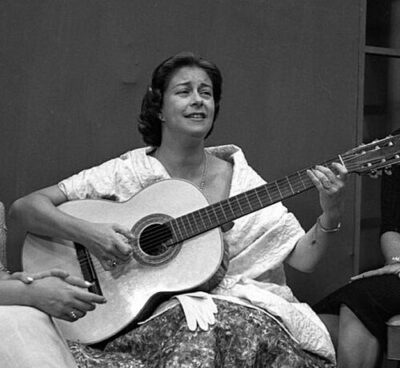
Chabuca Granda
Chabuca Granda was a Peruvian recording artist; composer and singer. Born September 3, 1920, in Cotabambas Auraria. Died March 8, 1983, in Miami. Known for La flor de la canela, José Antonio and Fina estampa. Awards include Order of the Sun of Peru, cultural heritage of Peru and Order of Francisco de Miranda.
Facts
38 facts · 2 confirmed by two sources · 8 cited · 28 from one source
Where this comes from
Papalocal keeps its own record. It started from these sources; what each one said is kept here as it was copied, so a change on their side never changes this page by itself. Tap one to read its version.
What Wikidata says · copied November 18, 2026 · revision 2565691630
- Described as
- Peruvian recording artist; composer and singer (1920–1983)
- Other names
- María Isabel Granda Larco, María Isabel Granda, María Isabel Granda y Larco
- Born
- September 3, 1920 · 2 references
- Died
- March 8, 1983 · 2 references
- Born in
- Cotabambas Auraria · 1 reference
- Died in
- Miami
- Buried in
- El Ángel Cemetery
- Cause of death
- cardiovascular disease
- Name at birth
- María Isabel Granda Larco · 1 reference
- Citizen of
- Peru
- Occupation
- singer · 1 reference; composer · 3 references; singer-songwriter; poet · 1 reference; recording artist; film screenwriter · 1 reference; playwright · 1 reference; lyricist
- Genre
- traditional folk music; música criolla; Andean music
- Instrument
- voice; guitar; piano
- Record label
- RCA Records; Sono Radio; IEMPSA; Microfon; Movieplay
- Known for
- La flor de la canela; José Antonio; Fina estampa; Cardo o ceniza; El puente de los suspiros
- Awards
- Order of the Sun of Peru (2019) · 1 reference; cultural heritage of Peru (2017); Order of Francisco de Miranda (1977); Order of Merit for Women (2004) · 1 reference; Latin Songwriters Hall of Fame (2015)
- Website
- http://chabucagranda.com.pe/
- Wikipedias with a page
- 20
Wikidata item Q2605806 (wikidata.org/wiki/Q2605806), public domain (CC0). Copied November 18, 2026.
What Wikipedia says · copied November 18, 2026 · revision 1373681764
María Isabel Granda Larco (3 September 1920 – 8 March 1983), better known as Chabuca Granda, was a Peruvian singer and composer. She created and interpreted a vast number of Criollo waltzes with Afro-Peruvian rhythms.
Granda's "La flor de la canela", "José Antonio", "El puente de los suspiros", and "Fina estampa" helped the singer receive international recognition. She has influenced various Peruvian artists such as Susana Baca, Eva Ayllón, Gian Marco and Juan Diego Flórez.
In 2017, her work was declared a Cultural Heritage of the Nation and in 2019, the Peruvian government posthumously awarded her the highest national honor, the Order of the Sun.
- Born, in its opening lines
- September 3, 1920
- Died, in its opening lines
- March 8, 1983
From the Wikipedia article “Chabuca Granda” (en.wikipedia.org/wiki/Chabuca_Granda), by its contributors, under CC BY-SA 4.0 (creativecommons.org/licenses/by-sa/4.0/). Copied November 18, 2026; not changed.
Confirmed Two sources agree. Cited One source, and it names where it got it. One source One source, without a reference of its own. Sources disagree The sources disagree. We show the best-supported value and keep theirs below.
