
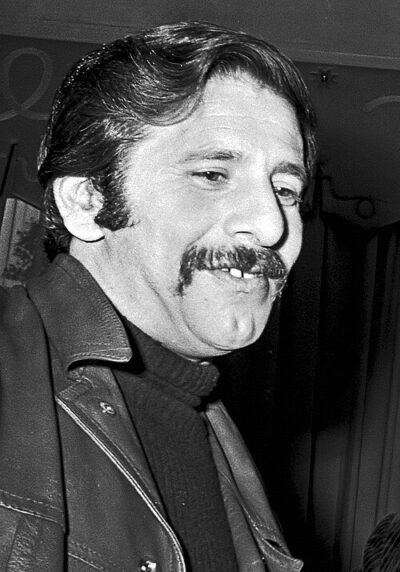
Chaim Topol
Chaim Topol was an Israeli actor. Born September 9, 1935, in Tel Aviv. Died March 8, 2023, in Tel Aviv. Awards include Israel Prize, honorary doctorate of Haifa University and Golden Globe Award for New Star of the Year – Actor.
Facts
27 facts · 2 confirmed by two sources · 7 cited · 18 from one source
Where this comes from
Papalocal keeps its own record. It started from these sources; what each one said is kept here as it was copied, so a change on their side never changes this page by itself. Tap one to read its version.
What Wikidata says · copied November 16, 2026 · revision 2567027819
- Described as
- Israeli actor (1935–2023)
- Other names
- Topol, Haim Topol, Hayim Topol
- Born
- September 9, 1935 · 3 references
- Died
- March 8, 2023 · 1 reference
- Born in
- Tel Aviv · 1 reference
- Died in
- Tel Aviv · 1 reference
- Cause of death
- Alzheimer's disease
- Citizen of
- Israel
- Occupation
- actor · 2 references; stage actor; dub actor; illustrator; painter; writer; poet; film actor
- Awards
- Israel Prize (2015); honorary doctorate of Haifa University; Golden Globe Award for New Star of the Year – Actor (1965) · 1 reference; Kinor David (1964); Golden Globe Award for Best Actor – Motion Picture Musical or Comedy · 1 reference; David di Donatello for Best Foreign Actor
- Field
- film acting · 1 reference
- Spouse
- Galia Topol (1956–2023) · 1 reference
- Children
- Adi Topol; Anat Topol; Omer Topol
- Religion
- Judaism
- Nickname
- Topol
- Wikipedias with a page
- 44
Wikidata item Q319133 (wikidata.org/wiki/Q319133), public domain (CC0). Copied November 16, 2026.
What Wikipedia says · copied November 16, 2026 · revision 1384036487
Chaim Topol (Hebrew: חיים טופול; 9 September 1935 – 8 March 2023), mononymously known as Topol, was an Israeli actor and singer who portrayed Tevye, the lead character in the stage musical Fiddler on the Roof. Topol estimated that he played Tevye more than 3,500 times on stage from 1967 through 2009, and he also portrayed the character in the 1971 film adaptation of the play.
Topol began acting during his Israeli army service as a member of the Nahal entertainment troupe. He later toured Israel with kibbutz theatre and satirical theatre companies. He was a co-founder of the Haifa Theatre. His breakthrough film role came in 1964 as the title character in Sallah Shabati, by Israeli writer Ephraim Kishon, for which he won a Golden Globe for Most Promising Newcomer—Male. Topol went on to appear in more than 30 films in Israel and the United States, including Galileo (1975), Flash Gordon (1980), and the James Bond film For Your Eyes Only (1981). He was described as Israel's only internationally recognized entertainer from the 1960s through the 1980s. He won a Golden Globe for Best Actor and was nominated for an Academy Award for Best Actor for his 1971 film portrayal of Tevye, and was nominated for a Tony Award for Best Actor for a 1991 Broadway revival of Fiddler on the Roof.
Topol was a founder of Variety Israel, an organization serving children with disabilities, and Jordan River Village, a year-round camp for Arab and Jewish children with life-threatening illnesses, for which he served as chairman of the board. In 2015 he was awarded the Israel Prize for lifetime achievement.
In October 2026 the documentary Topol: On Top of the World, directed by Alon Gur Arye and produced by Ofer Naim, premiered at the 42nd Haifa International Film Festival. Through the combination of interviews with him, his wife Galia, family members, colleagues and friends, and archival footage, the film portrays crucial decisions which led to successes and to passed up roles, which influenced his career. The film presents his charisma as well as his complexity.
- Born, in its opening lines
- September 9, 1935
- Died, in its opening lines
- March 8, 2023
From the Wikipedia article “Chaim Topol” (en.wikipedia.org/wiki/Chaim_Topol), by its contributors, under CC BY-SA 4.0 (creativecommons.org/licenses/by-sa/4.0/). Copied November 16, 2026; not changed.
Confirmed Two sources agree. Cited One source, and it names where it got it. One source One source, without a reference of its own. Sources disagree The sources disagree. We show the best-supported value and keep theirs below.
