
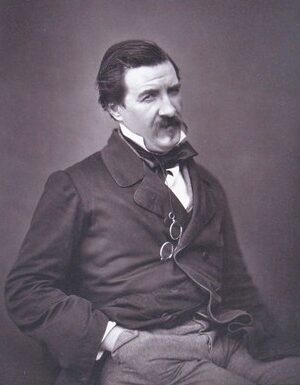
Champfleury
Champfleury was a French author. Born September 10, 1821, in Laon. Died December 6, 1889, in Sèvres. Positions held include curator (1876–). Known for Le Réalisme. Awards include Knight of the Legion of Honour.
Facts
18 facts · 1 confirmed by two sources · 6 cited · 10 from one source · 1 where the sources disagree
What’s different
- Born: we show September 10, 1821 (Sources disagree). Wikipedia says September 17, 1821
Where this comes from
Papalocal keeps its own record. It started from these sources; what each one said is kept here as it was copied, so a change on their side never changes this page by itself. Tap one to read its version.
What Wikidata says · copied November 18, 2026 · revision 2561523697
- Described as
- French author (1821–1889)
- Other names
- Jules Champfleury
- Born
- September 10, 1821 · 4 references
- Died
- December 6, 1889 · 7 references
- Born in
- Laon · 1 reference
- Died in
- Sèvres · 1 reference
- Buried in
- Cimetière des Bruyères
- Citizen of
- France · 1 reference
- Occupation
- writer · 2 references; novelist; literary critic; art critic; journalist · 1 reference; art historian · 2 references
- Positions held
- curator (1876–)
- Member of
- Société héliographique
- Genre
- essay
- Known for
- Le Réalisme (1857)
- Awards
- Knight of the Legion of Honour (1867) · 1 reference
- Siblings
- Édouard Fleury
- Wikipedias with a page
- 20
Wikidata item Q744488 (wikidata.org/wiki/Q744488), public domain (CC0). Copied November 18, 2026.
What Wikipedia says · copied November 18, 2026 · revision 1371042608
Jules François Felix Fleury-Husson (17 September 1821, in Laon, Aisne – 6 December 1889, in Sèvres), who wrote under the name Champfleury (French pronunciation: [ʃɑ̃fløʁi]), was a French art critic and novelist, a prominent supporter of the Realist movement in painting and fiction.
In 1843 Fleury-Husson moved to Paris. He met Charles Baudelaire and the next year started writing art criticism under the pen-name "Champfleury" for the journal L'Artiste. He was one of the first to promote the work of Gustave Courbet, in an article appearing in an issue of Le Pamphlet in 1848.
In 1856, during a time when the Spanish school was still largely ignored, he advocated the work of El Greco. He wrote about the Le Nain brothers and Maurice Quentin de La Tour. He also had a brief affair in 1851 with Eveline Hańska, the widow of his friend Honoré de Balzac.
He edited the periodical Le réalisme in 1856 and 1857.
His novels, of which the best-known is Les bourgeois de Molinchart (1854), were among the earliest Realist works.
In 1869 his book Les Chats, a series of essays about cats including portrayals of cats by prominent artists of the time, was published by Librairie de la Société Botanique de France, edited by J. Rothschild.
From 1872 until his death in 1889 he was Chief of Collections at the Sèvres porcelain factory.
The character of Marcel in Henri Murger's Scènes de la vie de bohème, and thus the corresponding character Marcello in Puccini's opera based on it, was partially based on Champfleury. Champfleury was a friend of Murger and they had roomed together for a time.
- Born, in its opening lines
- September 17, 1821
- Died, in its opening lines
- December 6, 1889
From the Wikipedia article “Champfleury” (en.wikipedia.org/wiki/Champfleury), by its contributors, under CC BY-SA 4.0 (creativecommons.org/licenses/by-sa/4.0/). Copied November 18, 2026; not changed.
Confirmed Two sources agree. Cited One source, and it names where it got it. One source One source, without a reference of its own. Sources disagree The sources disagree. We show the best-supported value and keep theirs below.
