
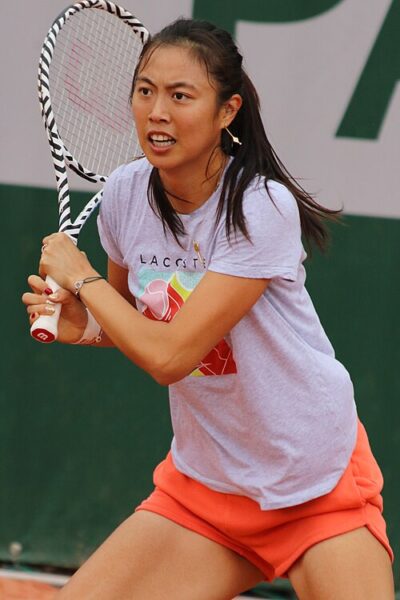
Chan Hao-Ching is a Taiwanese female tennis player. Born September 19, 1993, in Taichung. Teams include Chinese Taipei Billie Jean King Cup team (2015–). Educated at National Taiwan Sport University.
Facts
10 facts · 1 confirmed by two sources · 4 cited · 5 from one source
Where this comes from
Papalocal keeps its own record. It started from these sources; what each one said is kept here as it was copied, so a change on their side never changes this page by itself. Tap one to read its version.
What Wikidata says · copied November 17, 2026 · revision 2568090592
- Described as
- Taiwanese female tennis player
- Born
- September 19, 1993 · 1 reference
- Born in
- Taichung · 1 reference
- Citizen of
- Taiwan · 1 reference
- Occupation
- tennis player (2010–) · 1 reference
- Education
- National Taiwan Sport University
- Teams
- Chinese Taipei Billie Jean King Cup team (2015–)
- Sport
- tennis · 1 reference
- Siblings
- Latisha Chan · 1 reference
- Lived in
- Taipei
- Height
- 1.75 m (5 ft 9 in)
- Wikipedias with a page
- 27
Wikidata item Q452915 (wikidata.org/wiki/Q452915), public domain (CC0). Copied November 17, 2026.
What Wikipedia says · copied November 17, 2026 · revision 1385902786
Chan Hao-ching (Chinese: 詹皓晴; pinyin: Zhān Hàoqíng; Taiwanese Mandarin: [tsán.xâu.tɕʰǐŋ]; born September 19, 1993), also known as Angel Chan, is a Taiwanese professional tennis player. She is primarily a doubles specialist, having won twenty-two WTA Tour, three WTA Challenger and six ITF titles in that discipline. Chan reached the final of the mixed-doubles competition at Wimbledon with Max Mirnyi in 2014, her first major final. She reached two more finals in 2017, the Wimbledon women's doubles with Monica Niculescu, and the US Open mixed doubles with Michael Venus.
- Born, in its opening lines
- September 19, 1993
From the Wikipedia article “Chan Hao-ching” (en.wikipedia.org/wiki/Chan_Hao-ching), by its contributors, under CC BY-SA 4.0 (creativecommons.org/licenses/by-sa/4.0/). Copied November 17, 2026; not changed.
Confirmed Two sources agree. Cited One source, and it names where it got it. One source One source, without a reference of its own. Sources disagree The sources disagree. We show the best-supported value and keep theirs below.
