
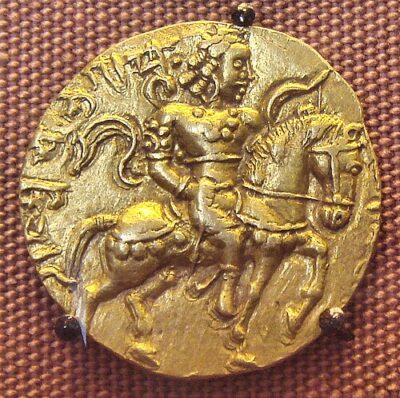
Chandragupta II
Chandragupta II was a Ruler of Gupta Empire from c. 375 to c. 415. Born 4th century. Died 5th century. Positions held include Gupta emperor (380–415) and emperor.
Facts
14 facts · 0 confirmed by two sources · 0 cited · 14 from one source
Where this comes from
Papalocal keeps its own record. It started from these sources; what each one said is kept here as it was copied, so a change on their side never changes this page by itself. Tap one to read its version.
What Wikidata says · copied November 16, 2026 · revision 2557836070
- Described as
- Ruler of Gupta Empire from c. 375 to c. 415
- Born
- 4th century
- Died
- 5th century
- Citizen of
- Gupta Empire
- Occupation
- monarch
- Positions held
- Gupta emperor (380–415); emperor
- Spouse
- Dhruvadevi
- Children
- Kumaragupta I; Prabhavatigupta; Govindagupta
- Father
- Samudragupta
- Mother
- Dattadevi
- Siblings
- Ramagupta
- Religion
- Hinduism
- Wikipedias with a page
- 44
Wikidata item Q844536 (wikidata.org/wiki/Q844536), public domain (CC0). Copied November 16, 2026.
What Wikipedia says · copied November 16, 2026 · revision 1385193912
Chandragupta II (died c. 415), also known by his title Vikramaditya, as well as Chandragupta Vikramaditya, was the emperor of the Gupta Empire from c. 375 until his death in c. 415. Modern scholars generally identify him with King Chandra of the Delhi iron pillar inscription.
He continued the expansionist policy of his father Samudragupta through military conquests and marital alliances. Historical evidence attests to his remarkable victories, which include the defeat of the Sassanids, the conquest of the Western Kshatrapas and the vassalization of the Hunas. Under the reign of Chandragupta II, the Gupta Empire reached its zenith, directly controlling a vast territory which stretched from the Oxus River in the west to the Bengal region in the east, and from the foothills of the Himalayas in the north to the Narmada River in the south. Chandragupta II expanded his influence and indirectly ruled over the Kuntala region of Karnataka through a marriage alliance with Kadambas, and during his daughter Prabhavatigupta's 20-year-long regency, he effectively integrated the Vakataka dynasty into the Gupta Empire.
Short Sanskrit inscriptions Found at the Sacred Rock of Hunza in Gilgit-Baltistan mention both Chandra and Harisena. Here Chandra is generally identified as Famous Gupta emperor Chandragupta ІІ and Harisena is identified with Gupta Courtier and minister of his father Emperor Samudragupta. Harisena is not just a Simple poet. The Allahabad Prayaga Prashasti Pillar Identifies him as a Sandhavigrahika(minister of peace and war), Kumaramatya(Senior adminstrative official). This positions shows Harisena held senior administrative position and significant military power under Samudragupta and the Udayagiri Cave Inscriptions demonstrates that experienced ministers could accompany Chandragupta II on royal military expeditions.
Famous Historians such as R.C.Majumdar have explored the possibility and pointed out that the combination of Chandra,Vikramaditya, and mention of Samudragupta's courtier Harisena on the Sacred Rocks of Hunza in Gilgit-Balitstan of Kashmir validates the claim mentioned in the Mehrauli Iron Pillar in Delhi claiming "Chandra" referring to "Chandragupta II Crossing Seven Mouths Of Indus to conquer the Vahlikas". Here the Vahlikas are commonly associated with Bactrian Region Around Balkh in present-day Afghanistan, Although the geographical identification remains debated. This validates the possibility of Military Expedition conducted by Chandragupta II crossing Indus River and defeating the Vahlikas as claimed in the Chandragupta's Mehrauli Iron Pillar .
Chandragupta II was a devout Vaishnava but tolerated other faiths as well. He was a great patron of learning, and his court is said to have hosted a group of nine scholars known as the Navaratnas (nine gems). His rule strengthened trade, culture, and administration, making him one of India's most celebrated monarchs. The Chinese pilgrim Faxian, who visited India during his reign, suggests that he ruled over a peaceful and prosperous kingdom. The legendary figure of Vikramaditya is probably based on Chandragupta II (among other kings), and the noted Sanskrit poet Kalidasa may have been his court poet. The cave shrines at Udayagiri were also built during his rule. He was succeeded by Kumaragupta I.
From the Wikipedia article “Chandragupta II” (en.wikipedia.org/wiki/Chandragupta_II), by its contributors, under CC BY-SA 4.0 (creativecommons.org/licenses/by-sa/4.0/). Copied November 16, 2026; not changed.
Confirmed Two sources agree. Cited One source, and it names where it got it. One source One source, without a reference of its own. Sources disagree The sources disagree. We show the best-supported value and keep theirs below.
