
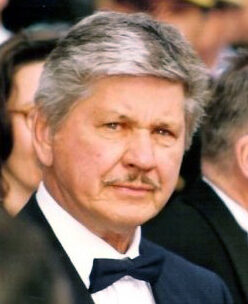
Charles Bronson
Charles Bronson was an American actor. Born November 3, 1921, in Ehrenfeld. Died August 30, 2003, in Los Angeles. Awards include Purple Heart, star on Hollywood Walk of Fame and Golden Boot Awards.
Facts
29 facts · 2 confirmed by two sources · 14 cited · 12 from one source · 1 where the sources disagree
What’s different
- Cause of death: we show pneumonia (Sources disagree). Wikidata also lists Alzheimer's disease
Where this comes from
Papalocal keeps its own record. It started from these sources; what each one said is kept here as it was copied, so a change on their side never changes this page by itself. Tap one to read its version.
What Wikidata says · copied November 13, 2026 · revision 2548979038
- Described as
- American actor (1921–2003)
- Other names
- Charles Dennis Buchinsky
- Born
- November 3, 1921 · 2 references
- Died
- August 30, 2003 · 8 references
- Born in
- Ehrenfeld
- Died in
- Los Angeles · 1 reference
- Buried in
- Brownsville Cemetery · 2 references
- Cause of death
- pneumonia; Alzheimer's disease
- Name at birth
- Charles Dennis Buchinsky · 1 reference
- Citizen of
- United States
- Occupation
- actor · 2 references; film actor; character actor; screenwriter; television actor; writer
- Genre
- Western
- Awards
- Purple Heart · 1 reference; star on Hollywood Walk of Fame (1980) · 2 references; Golden Boot Awards (1996) · 1 reference; Henrietta Award (1972) · 1 reference
- Spouse
- Jill Ireland (1968–1990) · 1 reference; Kim Weeks (1998–2003)
- Military branch
- United States Air Force · 2 references
- Military rank
- Corporal
- Lived in
- Bel Air · 1 reference; Malibu · 1 reference; Brownsville · 1 reference; Snowmass · 1 reference
- Height
- 1.74 m (5 ft 9 in)
- Website
- http://www.charlesbronson.info/
- Wikipedias with a page
- 97
Wikidata item Q36105 (wikidata.org/wiki/Q36105), public domain (CC0). Copied November 13, 2026.
What Wikipedia says · copied November 13, 2026 · revision 1383584148
Charles Bronson (born Charles Dennis Buchinsky; November 3, 1921 – August 30, 2003) was an American actor. He was known for his roles in action films and his "granite features and brawny physique". Bronson was born into extreme poverty in Ehrenfeld, Pennsylvania, a coal mining town in the Allegheny Mountains. Bronson's father, a miner, died when Bronson was young. Bronson himself worked in the mines as well until joining the United States Army Air Forces in 1943 to fight in World War II. After his service, he joined a theatrical troupe and studied acting. During the 1950s, he played various supporting roles in motion pictures and television, including anthology drama TV series in which he would appear as the main character. Near the end of the decade, he had his first cinematic leading role in Machine-Gun Kelly (1958).
Bronson had sizeable co-starring roles in The Magnificent Seven (1960), The Great Escape (1963), This Property Is Condemned (1966), and The Dirty Dozen (1967). Bronson also performed in many major television shows, and was nominated for an Emmy Award for his supporting role in an episode of General Electric Theater. Actor Alain Delon (who was a fan of Bronson) hired him to co-star with him in the French film Adieu l'ami (1968). That year, he also played one of the leads in the spaghetti Western, Once Upon a Time in the West (1968). Bronson continued playing leads in various action, Western, and war films made in Europe, including Rider on the Rain (1970), which won a Golden Globe Award for Best Foreign Language Film. During this time Bronson was the most popular American actor in Europe.
After this period, he returned to the United States to make more films, working with director Michael Winner. Their early collaborations included Chato's Land (1972), The Mechanic (1972) and The Stone Killer (1973). At this point, he became the world's top box-office star, commanding a salary of $1 million per film. In 1974, Bronson starred in the controversial film Death Wish (also directed by Winner), about an architect turned vigilante, a role that typified most of the characters he played for the rest of his career. Most critics initially panned the film as exploitative, but the movie was a major box-office success and spawned four sequels.
Until his retirement in the late 1990s, Bronson almost exclusively played lead roles in action-oriented films, such as Mr. Majestyk (1974), Hard Times (1975), St. Ives (1976), The White Buffalo (1977), Telefon (1977), and Assassination (1987). During this time he often collaborated with director J. Lee Thompson. He also made a number of non-action television films in which he acted against type. His last significant role in cinema was a supporting one in a dramatic film, The Indian Runner (1991); his performance in it was praised by reviewers.
- Born, in its opening lines
- November 3, 1921
- Died, in its opening lines
- August 30, 2003
From the Wikipedia article “Charles Bronson” (en.wikipedia.org/wiki/Charles_Bronson), by its contributors, under CC BY-SA 4.0 (creativecommons.org/licenses/by-sa/4.0/). Copied November 13, 2026; not changed.
Confirmed Two sources agree. Cited One source, and it names where it got it. One source One source, without a reference of its own. Sources disagree The sources disagree. We show the best-supported value and keep theirs below.
