
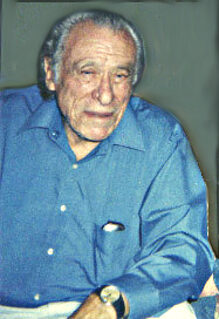
Charles Bukowski
Charles Bukowski was a German-American writer. Born August 16, 1920, in Andernach. Died March 9, 1994, in San Pedro. Known for Post Office, Factotum and Hollywood. Educated at Los Angeles City College and Los Angeles High School.
Facts
32 facts · 2 confirmed by two sources · 8 cited · 22 from one source
Where this comes from
Papalocal keeps its own record. It started from these sources; what each one said is kept here as it was copied, so a change on their side never changes this page by itself. Tap one to read its version.
What Wikipedia says · copied November 13, 2026 · revision 1382606058
Henry Charles Bukowski ( boo-KOW-skee; born Heinrich Karl Bukowski, German: [ˈhaɪnʁɪç ˈkaʁl buˈkɔfski]; August 16, 1920 – March 9, 1994) was a German-American poet, novelist, and short story writer. His writing was influenced by the social, cultural, and economic ambience of his adopted home city of Los Angeles. Bukowski's work addresses the ordinary lives of poor Americans, the act of writing, alcohol, relationships with women, and the drudgery of work.
The FBI kept a file on him as a result of his column Notes of a Dirty Old Man in the underground newspaper Open City.
Bukowski published extensively in small literary magazines and with small presses beginning in the early 1940s and continuing on through the early 1990s. He wrote thousands of poems, hundreds of short stories and six novels, eventually publishing over sixty books during the course of his career, including his Poems Written Before Jumping Out of an 8 Story Window, published by his friend and fellow poet Charles Potts, and Burning in Water, Drowning in Flame. His poems and stories were republished by John Martin's Black Sparrow Press (now HarperCollins/Ecco Press) as collected volumes of his work. As a reviewer noted, "Bukowski continued to be, thanks to his antics and deliberate clownish performances, the king of the underground… stressing his loyalty to those small press editors who had first championed his work."
Time called Bukowski a "laureate of American lowlife." Adam Kirsch of The New Yorker wrote, "the secret of Bukowski's appeal [is that] he combines the confessional poet's promise of intimacy with the larger-than-life aplomb of a pulp-fiction hero."
During his lifetime, Bukowski received little attention from academic critics in the United States, but was better received in Western Europe, particularly the United Kingdom, and especially Germany, where he was born. Since his death in March 1994, Bukowski's life and writings have been the subject of a number of articles and books.
- Born, in its opening lines
- August 16, 1920
- Died, in its opening lines
- March 9, 1994
From the Wikipedia article “Charles Bukowski” (en.wikipedia.org/wiki/Charles_Bukowski), by its contributors, under CC BY-SA 4.0 (creativecommons.org/licenses/by-sa/4.0/). Copied November 13, 2026; not changed.
What Wikidata says · copied November 14, 2026 · revision 2568960808
- Described as
- German-American writer (1920–1994)
- Other names
- Henry Charles Bukowski, Buk
- Born
- August 16, 1920 · 15 references
- Died
- March 9, 1994 · 14 references
- Born in
- Andernach · 2 references
- Died in
- San Pedro · 1 reference
- Buried in
- Green Hills Memorial Park · 2 references
- Cause of death
- leukemia
- Name at birth
- Heinrich Karl Bukowski
- Citizen of
- Germany; United States
- Occupation
- actor; writer · 2 references; screenwriter; poet · 2 references; novelist; journalist; author · 1 reference; columnist · 1 reference
- Education
- Los Angeles City College; Los Angeles High School · 1 reference; Susan Miller Dorsey High School · 1 reference
- Known for
- Post Office; Factotum; Hollywood; Ham on Rye; Pulp; Women; Notes of a Dirty Old Man; Erections, Ejaculations, Exhibitions, and General Tales of Ordinary Madness; South of No North; Hot Water Music
- Spouse
- Linda Lee Bukowski
- Website
- http://www.bukowski-gesellschaft.de · 1 reference
- Wikipedias with a page
- 106
Wikidata item Q76409 (wikidata.org/wiki/Q76409), public domain (CC0). Copied November 14, 2026.
Confirmed Two sources agree. Cited One source, and it names where it got it. One source One source, without a reference of its own. Sources disagree The sources disagree. We show the best-supported value and keep theirs below.
