
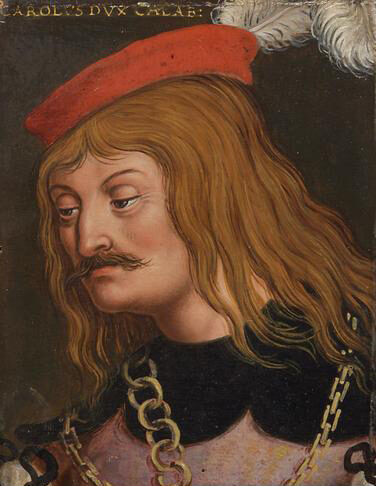
Charles, Duke of Calabria
Charles, Duke of Calabria was an Italian noble. Born May 28, 1298, in Naples. Died November 9, 1328, in Naples. Positions held include Prince of Naples.
Facts
15 facts · 2 confirmed by two sources · 0 cited · 13 from one source
Where this comes from
Papalocal keeps its own record. It started from these sources; what each one said is kept here as it was copied, so a change on their side never changes this page by itself. Tap one to read its version.
What Wikidata says · copied November 18, 2026 · revision 2553978756
- Described as
- Italian noble
- Other names
- Carlo, Duca di Calabria
- Born
- May 28, 1298
- Died
- November 9, 1328
- Born in
- Naples
- Died in
- Naples
- Buried in
- Santa Chiara · 1 reference
- Occupation
- aristocrat
- Positions held
- Prince of Naples
- Spouse
- Catherine of Austria, Duchess of Calabria (1316–) · 1 reference; Marie of Valois, Duchess of Calabria (1324–) · 1 reference
- Children
- Joanna I of Naples; Maria of Calabria; Charles Martel
- Father
- Robert, King of Naples
- Mother
- Yolande of Aragon, Duchess of Calabria
- Siblings
- Robert de Naples
- Wikipedias with a page
- 20
Wikidata item Q201737 (wikidata.org/wiki/Q201737), public domain (CC0). Copied November 18, 2026.
What Wikipedia says · copied November 18, 2026 · revision 1383970984
Charles, Duke of Calabria (1298 – 9 November 1328), was the Duke of Calabria from 1309 until his death. Upon his father's elevation as King of Naples, he was made vicar-general of Naples and duke of Calabria He was elected as signore by the city of Florence in 1326. Charles died on 9 November 1328 in Naples.
- Born, in its opening lines
- 1298
- Died, in its opening lines
- November 9, 1328
From the Wikipedia article “Charles, Duke of Calabria” (en.wikipedia.org/wiki/Charles,_Duke_of_Calabria), by its contributors, under CC BY-SA 4.0 (creativecommons.org/licenses/by-sa/4.0/). Copied November 18, 2026; not changed.
Confirmed Two sources agree. Cited One source, and it names where it got it. One source One source, without a reference of its own. Sources disagree The sources disagree. We show the best-supported value and keep theirs below.
