
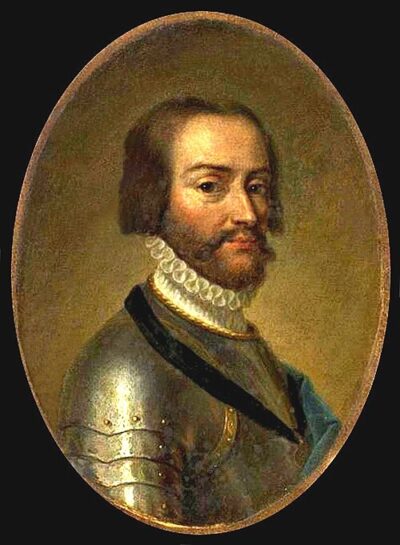
Charles, Duke of Vendôme was a French noble. Born June 2, 1489, in Vendôme. Died March 25, 1537, in Amiens.
Facts
26 facts · 2 confirmed by two sources · 2 cited · 22 from one source
Where this comes from
Papalocal keeps its own record. It started from these sources; what each one said is kept here as it was copied, so a change on their side never changes this page by itself. Tap one to read its version.
What Wikidata says · copied November 16, 2026 · revision 2550556201
- Described as
- French noble
- Other names
- Charles de Bourbon
- Born
- June 2, 1489
- Died
- March 25, 1537
- Born in
- Vendôme
- Died in
- Amiens
- Buried in
- collégiale Saint-Georges de Vendôme
- Citizen of
- France
- Occupation
- aristocrat
- Spouse
- Françoise d'Alençon (1513–) · 1 reference
- Children
- Antoine of Navarre; Francis, Count of Enghien · 1 reference; Charles, Cardinal de Bourbon; Louis, Prince of Condé; Jean, Count of Soissons and Enghien · 1 reference; Mary of Bourbon; Marguerite de Vendôme; Éléonore de Bourbon; Louis de Bourbon, Comte de Marle; Madeleine de Bourbon; Louis de Bourbon; Catherine de Bourbon
- Father
- Francis, Count of Vendôme
- Mother
- Marie of Luxembourg, Countess of Vendôme
- Siblings
- Louise de Bourbon; Antoinette de Bourbon; Francis de Bourbon, Count of Saint-Pol; Louis de Bourbon de Vendôme
- Wikipedias with a page
- 30
Wikidata item Q536033 (wikidata.org/wiki/Q536033), public domain (CC0). Copied November 16, 2026.
What Wikipedia says · copied November 16, 2026 · revision 1382145874
Charles de Bourbon, Duke of Vendôme (2 June 1489 – 25 March 1537) was a French soldier, governor, prince du sang and courtier during the reigns of King Louis XII and King Francis I. Charles was the son of Francis, Count of Vendôme, and Marie of Luxembourg. Beginning his military career in the Italian Wars of Louis XII, he saw service at the crushing French victory of Agnadello in 1509 and the capture of Genoa in 1507. With the death of the King Louis XII in 1515, he continued his service under King Francis. He was rewarded with the elevation of the County of Vendôme to the rank of the Duchy of Vendôme, and he was also made governor of the Île de France. He joined the king for his first Italian campaign in 1515. He thus participated in the Battle of Marignano. Returning to France, he traded his government of the Île de France for that of Picardy in 1519. It would be in Picardy he saw most of his military service for the rest of his life. He participated in the northern campaigns against the Holy Roman Empire first, then against England in 1521 and 1522, respectively. In 1523, his cousin, Charles III, Duke of Bourbon, defected to the Imperial cause. The king feared Vendôme might follow him in his treason and recalled him from Picardy. Thus Louis II, vicomte de Thouars, led the campaign in the north in 1523. The Duke of Vendôme, having proven his loyalty, was soon permitted to return north, and he played a role, alongside Thouars, in combatting the Chevauchée of the Duke of Suffolk that was threatening Paris in the Autumn. In late 1524, the king departed France to conquer Milan. His campaign ended in disaster at the Battle of Pavia, at which he was captured.
Vendôme had been entrusted with the defence of Picardy during the king's absence and was not at Pavia. Thus he had a key role to play in the regency government of the king's mother Louise. Along with several other key military figures he was responsible for the defence of the kingdom at a very sensitive moment. He had also become the premier prince du sang with the death of the duc d'Alençon, putting him fourth in the line of succession. He was frustrated by his situation, as though he was the nominal chair of the royal council in Lyon, he was unable to prevent Louise favouring the vicomte de Lautrec over him and snubbing his wife's rights to the Alençon inheritance. Nevertheless, though a faction in the Paris Parlement wished for him to usurp the regency, he did not put himself at the head of an opposition party. In 1526, Francis was conditionally released from his captivity and the regency ended. With it ended Vendôme's central position in the government. In the coming years he was present for many important ceremonies, such as the king's special sessions of the parlement, meetings with the English and the release of the king's sons from captivity. In December 1527 he led the nobility at a meeting called by the king to endorse his breaking of the terms of the treaty of Madrid by which he had secured his freedom after Pavia. He assured Francis on behalf of the nobility that they would devote their lives and property to him.
A new crisis emerged for the kingdom in 1536. Vendôme worked to secure funds for his soldiers in Picardy, and came into conflict with the cardinal du Bellay who the king had placed in charge with Paris. Vendôme was frustrated by the quality of his troops, and what he felt were insufficient exertions by du Bellay to support him. The Imperial siege of Thérouanne would fail, and with it the crisis passed. Vendôme was again involved in the campaign of 1537, however he came over ill in March and died in Amiens on 25 March. His grandson would become king of France as Henry IV.
- Born, in its opening lines
- June 2, 1489
- Died, in its opening lines
- March 25, 1537
From the Wikipedia article “Charles, Duke of Vendôme” (en.wikipedia.org/wiki/Charles,_Duke_of_Vendôme), by its contributors, under CC BY-SA 4.0 (creativecommons.org/licenses/by-sa/4.0/). Copied November 16, 2026; not changed.
Confirmed Two sources agree. Cited One source, and it names where it got it. One source One source, without a reference of its own. Sources disagree The sources disagree. We show the best-supported value and keep theirs below.
