
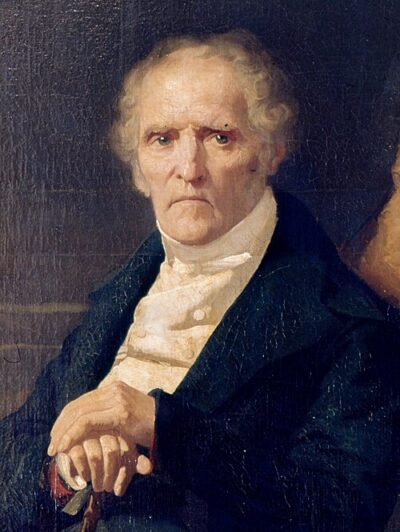
Charles Fourier
Charles Fourier was a French utopian socialist and philosopher. Born April 7, 1772, in Besançon. Died October 10, 1837, in Paris. Known for phalanstère.
Facts
14 facts · 2 confirmed by two sources · 5 cited · 7 from one source
Where this comes from
Papalocal keeps its own record. It started from these sources; what each one said is kept here as it was copied, so a change on their side never changes this page by itself. Tap one to read its version.
What Wikidata says · copied November 16, 2026 · revision 2561132600
- Described as
- French utopian socialist and philosopher (1772–1837)
- Born
- April 7, 1772 · 12 references
- Died
- October 10, 1837 · 8 references
- Born in
- Besançon
- Died in
- Paris
- Buried in
- Montmartre Cemetery · 1 reference
- Name at birth
- François Marie Charles Fourier
- Citizen of
- France
- Occupation
- economist · 1 reference; sociologist; philosopher · 2 references; writer · 1 reference; socialist · 1 reference
- Known for
- phalanstère
- Field
- Fourierism
- Wikipedias with a page
- 77
Wikidata item Q181707 (wikidata.org/wiki/Q181707), public domain (CC0). Copied November 16, 2026.
What Wikipedia says · copied November 16, 2026 · revision 1384513428
François Marie Charles Fourier (; French: [ʃaʁl fuʁje]; 7 April 1772 – 10 October 1837) was a French philosopher regarded as having founded the concept of utopian socialism. His views, held to be radical in his lifetime, have appeared more frequently in the contemporary world—the use of the word feminisme in Fourier's 1837 edition of his Théorie des quatre mouvements et des destinées générales (Theory of the Four Movements and the General Destinies) has been regarded as formative on the development of feminism.
Fourier's social views and proposals inspired a movement of intentional communities. Among them in the United States were the community of Utopia, Ohio; La Reunion near present-day Dallas, Texas; Lake Zurich, Illinois; the North American Phalanx in Red Bank, New Jersey; Brook Farm in West Roxbury, Massachusetts; the Community Place and Sodus Bay Phalanx in New York State; Silkville, Kansas, and several others. In Guise, France, he influenced the Familistery of Guise. Fourier later inspired a diverse array of revolutionary thinkers and writers.
- Born, in its opening lines
- April 7, 1772
- Died, in its opening lines
- October 10, 1837
From the Wikipedia article “Charles Fourier” (en.wikipedia.org/wiki/Charles_Fourier), by its contributors, under CC BY-SA 4.0 (creativecommons.org/licenses/by-sa/4.0/). Copied November 16, 2026; not changed.
Confirmed Two sources agree. Cited One source, and it names where it got it. One source One source, without a reference of its own. Sources disagree The sources disagree. We show the best-supported value and keep theirs below.
