
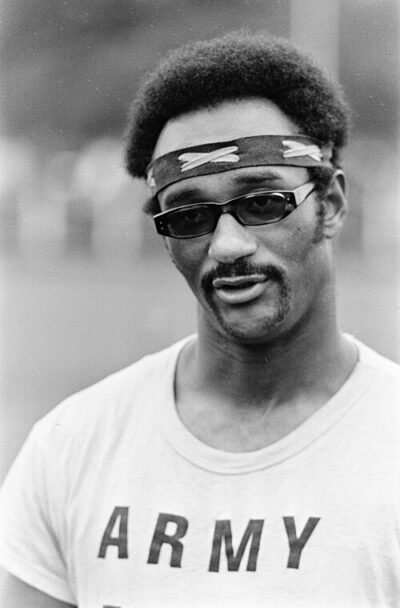
Charles Greene
Charles Greene was an American sprinter. Born March 21, 1945, in Pine Bluff. Died March 14, 2022, in Lincoln. Educated at University of Nebraska–Lincoln and O'Dea High School.
Facts
11 facts · 2 confirmed by two sources · 5 cited · 4 from one source
Where this comes from
Papalocal keeps its own record. It started from these sources; what each one said is kept here as it was copied, so a change on their side never changes this page by itself. Tap one to read its version.
What Wikidata says · copied November 16, 2026 · revision 2567190998
- Described as
- American sprinter (1945–2022)
- Born
- March 21, 1945 · 1 reference
- Died
- March 14, 2022 · 1 reference
- Born in
- Pine Bluff · 1 reference
- Died in
- Lincoln · 1 reference
- Citizen of
- United States
- Occupation
- athletics competitor · 1 reference
- Education
- University of Nebraska–Lincoln · 1 reference; O'Dea High School · 1 reference
- Member of
- Kappa Alpha Psi
- Sport
- athletics
- Height
- 1.73 m (5 ft 8 in) · 1 reference
- Wikipedias with a page
- 24
Wikidata item Q1064623 (wikidata.org/wiki/Q1064623), public domain (CC0). Copied November 16, 2026.
What Wikipedia says · copied November 16, 2026 · revision 1364085666
Charles Edward "Charlie" Greene (March 21, 1945 – March 14, 2022) was an American track and field sprinter and winner of the gold medal in the 4 × 100 metres relay at the 1968 Summer Olympics.
Born in Pine Bluff, Arkansas, Greene was considered a certain candidate for the 1964 Olympic team, but he suffered a muscle pull which held him to a sixth-place finish at the Olympic Trials.
Greene won the 100-yard dash for O'Dea High School in Seattle in 1962 and 1963 and also the 220-yard dash in 1963. Greene won the Amateur Athletic Union (AAU) championships in the 100-yard dash in 1966 and in the 100-meter dash in 1968. At the 1968 AAU Championships, Greene tied the 100 m world record twice. First in the heats, he equaled the world record of 10.0 seconds. In the second semifinal, he achieved a time of 9.9 seconds, the same time which had been run by Jim Hines and Ronnie Ray Smith in the previous race. The evening when the three men equaled the world record (and several others were very close), June 20, 1968, at Hughes Stadium in Sacramento, California has been dubbed by track and field historians as the "Night of Speed". As a University of Nebraska student, Greene won the National Collegiate Athletic Association (NCAA) championships in the 100-yard dash from 1965 to 1967 and tied the world record at 9.1 seconds.
At the 1968 Olympics in Mexico, Greene felt pain in his left hamstring late in the race and was third in the 100-meter dash. He was the fastest man in the trials and semifinals, but before the final race he was injured although started anyway with a bandaged leg. Despite the injury, he also led off the American 4 × 100 metres relay team which won the gold medal and set a new world record of 38.24 seconds.
Following his athletic career, Greene became a United States Army officer, serving as the sprint coach at West Point and head coach of the All-Army team. After retiring from the Army with the rank of Major, he became a director for Special Olympics International.
In 2007, Charles Greene became the sprints coach at Lincoln Northeast High School in Lincoln, Nebraska. He coached multiple state qualifiers in his first year along with the state's third-place 4 × 100 metres relay team of Logan Reising, Brian May, Tory Berks, and AJ Robinson.
Greene, who spent most of his childhood in Seattle, Washington, was slowed down later in life due to a number of medical complications and surgeries. He died in Lincoln, Nebraska on March 14, 2022, at the age of 76.
- Born, in its opening lines
- March 21, 1945
- Died, in its opening lines
- March 14, 2022
From the Wikipedia article “Charles Greene (sprinter)” (en.wikipedia.org/wiki/Charles_Greene_(sprinter)), by its contributors, under CC BY-SA 4.0 (creativecommons.org/licenses/by-sa/4.0/). Copied November 16, 2026; not changed.
Confirmed Two sources agree. Cited One source, and it names where it got it. One source One source, without a reference of its own. Sources disagree The sources disagree. We show the best-supported value and keep theirs below.
