
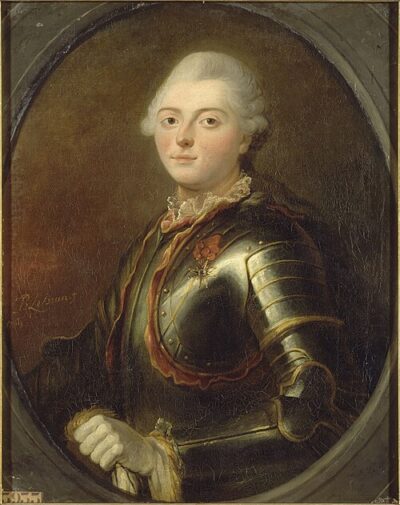
Charles Hector, comte d'Estaing
Charles Hector, comte d'Estaing was a French admiral during the War of American Independence. Born November 24, 1729, in Château de Ravel. Died April 28, 1794, in Paris. Awards include Knight of the Order of the Holy Spirit, Knight of the Order of Saint Michael and Marshal of France.
Facts
17 facts · 2 confirmed by two sources · 2 cited · 13 from one source
Where this comes from
Papalocal keeps its own record. It started from these sources; what each one said is kept here as it was copied, so a change on their side never changes this page by itself. Tap one to read its version.
What Wikidata says · copied November 18, 2026 · revision 2553945054
- Described as
- French admiral during the War of American Independence (1729-1794)
- Born
- November 24, 1729 · 4 references
- Died
- April 28, 1794 · 4 references
- Born in
- Château de Ravel
- Died in
- Paris
- Cause of death
- decapitation by guillotine
- Citizen of
- France
- Occupation
- politician; military personnel
- Awards
- Knight of the Order of the Holy Spirit; Knight of the Order of Saint Michael; Marshal of France; Admiral of France
- Father
- Comte Charles François d'Estaing, Marquis de Saillans, Vicomte de Ravel · 1 reference
- Mother
- Marie Henriette Colbert · 1 reference
- Military branch
- French Army; French Navy
- Military rank
- admiral
- Wikipedias with a page
- 22
Wikidata item Q694048 (wikidata.org/wiki/Q694048), public domain (CC0). Copied November 18, 2026.
What Wikipedia says · copied November 18, 2026 · revision 1384924959
Jean Baptiste Charles Henri Hector, Count of Estaing (French: [ʃaʁl ɑ̃ʁi dɛstɛ̃]; 24 November 1729 – 28 April 1794) was a French military officer and writer. He began his service as a soldier in the War of the Austrian Succession, briefly spending time as a prisoner of war of the British during the Seven Years' War. Naval exploits during the latter war prompted him to change branches of service, and he transferred to the French Navy.
Following France's entry into the American War of Independence in 1778, Estaing led a fleet to aid the American rebels. He participated in a failed Franco-American siege of Newport, Rhode Island, in 1778, and the equally unsuccessful 1779 Siege of Savannah. He did have success in the Caribbean before returning to France in 1780. His difficulties working with American counterparts are cited among the reasons these operations in North America failed.
Although Estaing sympathized with revolutionaries during the French Revolution, he held a personal loyalty to the French royal family. Because of this he came under suspicion, and was executed by guillotine in the Reign of Terror.
- Born, in its opening lines
- November 24, 1729
- Died, in its opening lines
- April 28, 1794
From the Wikipedia article “Charles Henri Hector, Count of Estaing” (en.wikipedia.org/wiki/Charles_Henri_Hector,_Count_of_Estaing), by its contributors, under CC BY-SA 4.0 (creativecommons.org/licenses/by-sa/4.0/). Copied November 18, 2026; not changed.
Confirmed Two sources agree. Cited One source, and it names where it got it. One source One source, without a reference of its own. Sources disagree The sources disagree. We show the best-supported value and keep theirs below.
