
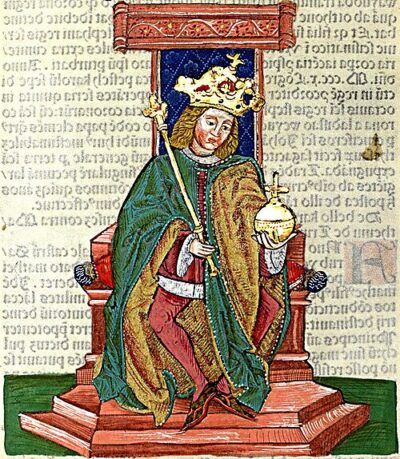
Charles I of Hungary was a King of Hungary. Born 1288, in Naples. Died July 16, 1342, in Visegrád. Positions held include Apostolic King of Hungary (1308–1342).
Facts
23 facts · 2 confirmed by two sources · 5 cited · 15 from one source · 1 where the sources disagree
What’s different
- Buried in: we show Székesfehérvár (Sources disagree). Wikidata also lists Székesfehérvár Basilica
Where this comes from
Papalocal keeps its own record. It started from these sources; what each one said is kept here as it was copied, so a change on their side never changes this page by itself. Tap one to read its version.
What Wikidata says · copied November 16, 2026 · revision 2558104609
- Described as
- King of Hungary
- Other names
- Károly Róbert, Charles Robert
- Born
- 1288 · 2 references
- Died
- July 16, 1342 · 3 references
- Born in
- Naples · 1 reference
- Died in
- Visegrád
- Buried in
- Székesfehérvár Basilica; Székesfehérvár · 1 reference
- Citizen of
- Hungary
- Occupation
- monarch · 1 reference
- Positions held
- Apostolic King of Hungary (1308–1342) · 1 reference
- Spouse
- Elizabeth of Poland, Queen of Hungary (1320–) · 1 reference; Beatrice of Luxembourg (1318–) · 1 reference; Maria of Bytom (1306–) · 1 reference; Maria of Halych
- Children
- Louis I of Hungary; Andrew, Duke of Calabria; Stephen, Duke of Slavonia; Catherine of Hungary, Duchess of Świdnica; Coloman of Hungary; Charles of Hungary · 1 reference; Lasislaus of Hungary · 1 reference
- Father
- Charles Martel of Anjou
- Mother
- Clemence of Austria
- Siblings
- Clementia of Hungary; Beatrice of Hungary, Dauphine of Viennois
- Wikipedias with a page
- 49
Wikidata item Q213061 (wikidata.org/wiki/Q213061), public domain (CC0). Copied November 16, 2026.
What Wikipedia says · copied November 16, 2026 · revision 1364430559
Charles I, also known as Charles Robert (Hungarian: Károly Róbert; Croatian: Karlo Robert; Slovak: Karol Róbert; Italian: Caroberto; (1288 – 16 July 1342), was King of Hungary and Croatia from 1308 to his death. He was a member of the Capetian House of Anjou and the only son of Charles Martel, Prince of Salerno. His father was the eldest son of Charles II of Naples and Mary of Hungary. Mary laid claim to Hungary after her brother, Ladislaus IV of Hungary, died in 1290, but the Hungarian prelates and lords elected her cousin, Andrew III, king. Instead of abandoning her claim to Hungary, she transferred it to her son, Charles Martel, and after his death in 1295, to her grandson, Charles. On the other hand, her husband, Charles II of Naples, made their third son, Robert, heir to the Kingdom of Naples, thus disinheriting Charles.
Charles came to the Kingdom of Hungary upon the invitation of an influential Croatian lord, Paul Šubić, in August 1300. Andrew III died on 14 January 1301, and within four months Charles was crowned king, but with a provisional crown instead of the Holy Crown of Hungary. Most Hungarian noblemen refused to yield to him and elected Wenceslaus of Bohemia king. Charles withdrew to the southern regions of the kingdom. Pope Boniface VIII acknowledged Charles as the lawful king in 1303, but Charles was unable to strengthen his position against his opponent. Wenceslaus abdicated in favor of Otto of Bavaria in 1305. Because it had no central government, the Kingdom of Hungary had disintegrated into a dozen provinces, each headed by a powerful nobleman, or oligarch. One of those oligarchs, Ladislaus III Kán, captured and imprisoned Otto of Bavaria in 1307. Charles was elected king in Pest on 27 November 1308, but his rule remained nominal in most parts of his kingdom even after he was crowned with the Holy Crown on 27 August 1310.
Charles won his first decisive victory in the Battle of Rozgony (at present-day Rozhanovce in Slovakia) on 15 June 1312. After that, his troops seized most fortresses of the powerful Aba family. During the next decade, Charles restored royal power primarily with the assistance of the prelates and lesser noblemen in most regions of the kingdom. After the death of the most powerful oligarch, Matthew Csák, in 1321, Charles became the undisputed ruler of the whole kingdom, with the exception of Croatia where local noblemen were able to preserve their autonomous status. He was not able to hinder the development of Wallachia into an independent principality after his defeat in the Battle of Posada in 1330. Charles's contemporaries described his defeat in that battle as a punishment from God for his cruel revenge against the family of Felician Záh who had attempted to slaughter the royal family.
Charles rarely made perpetual land grants, instead introducing a system of "office fiefs", whereby his officials enjoyed significant revenues, but only for the time they held a royal office, which ensured their loyalty. In the second half of his reign, Charles did not hold Diets and administered his kingdom with absolute power. He established the Order of Saint George, which was the first secular order of knights. He promoted the opening of new gold mines, which made Hungary the largest producer of gold in Europe. The first Hungarian gold coins were minted during his reign. At the congress of Visegrád in 1335, he mediated a reconciliation between two neighboring monarchs, John of Bohemia and Casimir III of Poland. Treaties signed at the same congress also contributed to the development of new commercial routes linking Hungary with Western Europe. Charles's efforts to reunite Hungary, together with his administrative and economic reforms, established the basis for the achievements of his successor, Louis the Great.
- Born, in its opening lines
- 1288
- Died, in its opening lines
- July 16, 1342
From the Wikipedia article “Charles I of Hungary” (en.wikipedia.org/wiki/Charles_I_of_Hungary), by its contributors, under CC BY-SA 4.0 (creativecommons.org/licenses/by-sa/4.0/). Copied November 16, 2026; not changed.
Confirmed Two sources agree. Cited One source, and it names where it got it. One source One source, without a reference of its own. Sources disagree The sources disagree. We show the best-supported value and keep theirs below.
