
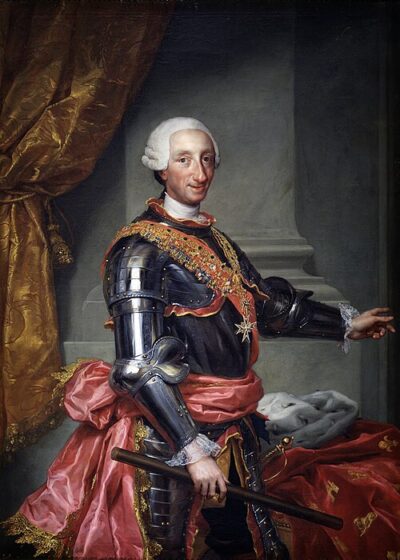
Charles III of Spain
Charles III of Spain was a King of Spain from 1759 to 1788. Born January 20, 1716, in Madrid. Died December 14, 1788, in Madrid. Positions held include Monarch of Spain (1759–1788), King of Naples (1734–1759) and King of Sicily (1734–1759). Awards include Knight of the Order of the Holy Spirit, Knight of the Order of Saint Michael and Knight of the Order of the Golden Fleece.
Facts
41 facts · 2 confirmed by two sources · 13 cited · 26 from one source
Where this comes from
Papalocal keeps its own record. It started from these sources; what each one said is kept here as it was copied, so a change on their side never changes this page by itself. Tap one to read its version.
What Wikidata says · copied November 16, 2026 · revision 2569156759
- Described as
- King of Spain from 1759 to 1788
- Other names
- Charles VII of Naples, Charles V of Sicily, Carlos III, Charles III, Charles I of Parma
- Born
- January 20, 1716 · 9 references
- Died
- December 14, 1788 · 10 references
- Born in
- Madrid · 3 references
- Died in
- Madrid · 3 references
- Buried in
- Royal Crypt of the Royal Monastery of San Lorenzo de El Escorial
- Citizen of
- Spain · 1 reference
- Occupation
- ruler
- Positions held
- Monarch of Spain (1759–1788); King of Naples (1734–1759); King of Sicily (1734–1759); Head of State of Spain (1759–1788)
- Awards
- Knight of the Order of the Holy Spirit; Knight of the Order of Saint Michael; Knight of the Order of the Golden Fleece; illustrious son · 1 reference
- Spouse
- Maria Amalia of Saxony (1738–1760) · 1 reference
- Children
- Infanta Maria Josefa of Spain; Maria Luisa of Spain; Charles IV of Spain · 1 reference; Ferdinand I of the Two Sicilies · 1 reference; Infante Gabriel of Spain; Infante Antonio Pascual of Spain; Infante Francisco Javier of Spain; Maria Isabel de Borbón · 1 reference; Maria Josefa Antoinetta de Borbón · 1 reference; Maria Isabel Ana de Borbón · 1 reference; Infante Philip, Duke of Calabria · 1 reference; Maria Teresa de Borbón · 1 reference
- Father
- Philip V of Spain
- Mother
- Elisabeth Farnese · 1 reference
- Siblings
- Mariana Victoria of Spain; Maria Teresa Rafaela of Spain; María Antonia of Spain; Filippo I, Duke of Parma; Infante Luis, Count of Chinchón · 1 reference; Francisco of Spain; Louis I of Spain; Ferdinand VI of Spain
- Religion
- Catholicism
- Military rank
- general
- Lived in
- Royal Palace of Madrid · 1 reference
- Wikipedias with a page
- 74
Wikidata item Q36234 (wikidata.org/wiki/Q36234), public domain (CC0). Copied November 16, 2026.
What Wikipedia says · copied November 16, 2026 · revision 1384188772
Charles III (Spanish: Carlos Sebastián de Borbón y Farnesio; 20 January 1716 – 14 December 1788) was King of Spain from 1759 until his death in 1788. He was also Duke of Parma and Piacenza as Charles I (1731–1735), King of Naples as Charles VII and King of Sicily as Charles III (or V) (1735–1759). He was the fourth son of Philip V of Spain and the eldest son of Philip's second wife, Elisabeth Farnese. During his reign, Charles was a proponent of enlightened absolutism and regalism in Europe.
In 1731, the 15-year-old Charles became Duke of Parma and Piacenza following the death of his childless grand-uncle Antonio Farnese. At the age of 18, he led Spanish troops in a bold and almost entirely bloodless march down Italy to seize the Kingdom of Naples and Kingdom of Sicily and enforce the Spanish claim to their thrones. In 1738, he married the Princess Maria Amalia of Saxony, daughter of Augustus III of Poland, having 13 children, eight of whom reached adulthood. They resided in Naples for 19 years. Charles gained valuable experience in his 25-year rule in Italy, so that he was well prepared as the monarch of the Spanish Empire. His policies in Italy prefigured ones he would put in place in his 30-year rule of Spain.
Charles succeeded to the Spanish throne in 1759 upon the death of his childless half-brother Ferdinand VI. As king of Spain, Charles III made far-reaching reforms to increase the flow of funds to the crown and defend against foreign incursions on the empire. He facilitated trade and commerce, modernized agriculture and land tenure, and promoted science and university research. He implemented regalist policies to increase the power of the state regarding the church. During his reign, he expelled the Jesuits from the Spanish Empire and fostered the Enlightenment in Spain. Charles launched enquiries into the Iberian Peninsula's Muslim past, even after succeeding to the Spanish throne. He strengthened the Spanish Army and the Spanish Navy. Although he did not achieve complete control over Spain's finances, and was sometimes obliged to borrow to meet expenses, most of his reforms proved successful in providing increased revenue to the crown and expanding state power, leaving a lasting legacy.
His regime enacted a series of sweeping reforms with the aim of bringing the overseas territories under firmer control, reversing the trend toward local autonomy, and gaining more control over the Church. Reforms including the establishment of two new viceroyalties, realignment of administration into intendancies, creating a standing military, establishing new monopolies, revitalizing silver mining, excluding American-born Spaniards (criollos) from high civil and ecclesiastical offices, and eliminating many privileges (fueros) of clergy. With the outbreak of the American Revolutionary War, he reluctantly supported the rebel side, after which his council entertained peacefully separating the Spanish overseas territories to avoid their own revolt, although this was ultimately not followed. Charles also ambitioned to peacefully reunite Spain and Portugal and considered similar propositions about it.
Historian Stanley Payne writes that Charles "was probably the most successful European ruler of his generation. He had provided firm, consistent, intelligent leadership. He had chosen capable ministers ... [his] personal life had won the respect of the people." John Lynch's assessment is that in Bourbon Spain "Spaniards had to wait half a century before their government was rescued by Charles III."
- Born, in its opening lines
- January 20, 1716
- Died, in its opening lines
- December 14, 1788
From the Wikipedia article “Charles III of Spain” (en.wikipedia.org/wiki/Charles_III_of_Spain), by its contributors, under CC BY-SA 4.0 (creativecommons.org/licenses/by-sa/4.0/). Copied November 16, 2026; not changed.
Confirmed Two sources agree. Cited One source, and it names where it got it. One source One source, without a reference of its own. Sources disagree The sources disagree. We show the best-supported value and keep theirs below.
