
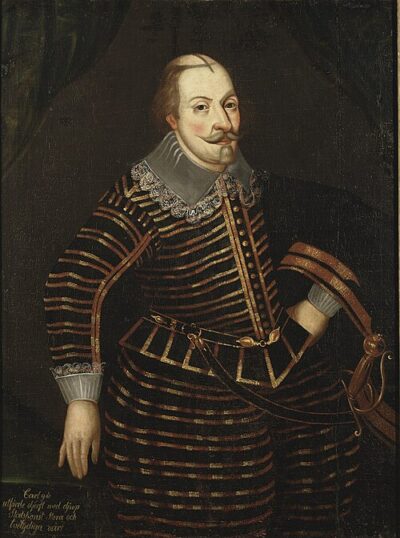
Charles IX of Sweden
Charles IX of Sweden was a King of Sweden in 1604–1611. Born October 4, 1550, in Tre Kronor Castle. Died October 30, 1611, in Nyköping Castle. Positions held include Monarch of Sweden (1604–1611).
Facts
28 facts · 2 confirmed by two sources · 8 cited · 18 from one source
Where this comes from
Papalocal keeps its own record. It started from these sources; what each one said is kept here as it was copied, so a change on their side never changes this page by itself. Tap one to read its version.
What Wikidata says · copied November 16, 2026 · revision 2569004919
- Described as
- King of Sweden in 1604–1611
- Other names
- Karl IX, Karl Vasa, Karl Gustavsson Vasa, Charles Vasa, Karl IX of Sweden, Charles IX
- Born
- October 4, 1550 · 8 references
- Died
- October 30, 1611 · 6 references
- Born in
- Tre Kronor Castle · 1 reference
- Died in
- Nyköping Castle · 1 reference
- Buried in
- Strängnäs Cathedral · 1 reference
- Citizen of
- Sweden
- Occupation
- monarch
- Positions held
- Monarch of Sweden (1604–1611)
- Spouse
- Maria of the Palatinate-Simmern (1579–) · 3 references; Christina of Schleswig-Holstein-Gottorp (1592–) · 3 references
- Children
- Catherine of Sweden, Countess Palatine of Kleeburg; Gustavus Adolphus of Sweden · 1 reference; Princess Maria Elizabeth of Sweden; Charles Philip, Duke of Södermanland; Carl Gyllenhielm; Elisabeth Sabina of Sweden; Christine Wasa
- Father
- Gustav I of Sweden · 2 references
- Mother
- Margaret Leijonhufvud · 2 references
- Siblings
- John III of Sweden; Catherine Vasa of Sweden; Princess Cecilia of Sweden; Magnus, Duke of Östergötland; Anna of Sweden; Princess Sophia of Sweden; Princess Elizabeth of Sweden; Eric XIV of Sweden
- Religion
- Lutheranism
- Wikipedias with a page
- 62
Wikidata item Q52939 (wikidata.org/wiki/Q52939), public domain (CC0). Copied November 16, 2026.
What Wikipedia says · copied November 16, 2026 · revision 1384968216
Charles IX, also Carl (Swedish: Karl IX; 4 October 1550 – 30 October 1611), reigned as King of Sweden from 1604 until 1611. He was the youngest son of King Gustav I (r. 1523–1560) and his second wife, Margaret Leijonhufvud, the brother of King John III and half-brother of King Erik XIV, and the uncle of Sigismund, who became king both of Sweden and of Poland. By his father's will, Charles received, by way of appanage, the Duchy of Södermanland, which included the provinces of Närke and Värmland; but he did not come into actual possession of them till after the fall of Eric and the succession to the throne of John in 1569.
He came into the throne by championing the Protestant cause during the increasingly tense times of religious strife between competing sects of Christianity. Just under a decade after his death, these would re-ignite in the Thirty Years' War of 1618–1648. These conflicts had already caused the dynastic squabble rooted in religious freedom that deposed Charles' nephew (Sigismund III) and brought Charles to rule as king of Sweden.
His reign marked the start of the final chapter (dated 1648 by some) both of the Reformation and of the Counter-Reformation. With the death of his brother John III of Sweden in November 1592, the Swedish throne went to his nephew, the Habsburg ally Sigismund of Poland and Sweden. During these tense political times, Charles viewed the inheritance of the throne of Protestant Sweden by his devout Catholic nephew with alarm. Several years of religious controversy and discord followed.
While King Sigismund resided in Poland, Charles and the Swedish privy council ruled in Sigismund's name. After various preliminaries, the Riksdag of the Estates forced Sigismund to abdicate the throne to Charles IX in 1595. This eventually kicked off nearly seven decades of sporadic warfare as the two lines of the divided House of Vasa both continued to attempt to remake the union between the Polish and Swedish thrones with opposing counter-claims and dynastic wars.
Quite likely, the dynastic outcome between the Swedish and Polish representatives of the House of Vasa exacerbated and radicalized the later actions of Europe's Catholic princes in the German states such as the Edict of Restitution of 1629. In fact, it worsened European politics to the abandonment or prevention of settling events by diplomacy and compromise during the vast bloodletting of the Thirty Years' War.
- Born, in its opening lines
- October 4, 1550
- Died, in its opening lines
- October 30, 1611
From the Wikipedia article “Charles IX of Sweden” (en.wikipedia.org/wiki/Charles_IX_of_Sweden), by its contributors, under CC BY-SA 4.0 (creativecommons.org/licenses/by-sa/4.0/). Copied November 16, 2026; not changed.
Confirmed Two sources agree. Cited One source, and it names where it got it. One source One source, without a reference of its own. Sources disagree The sources disagree. We show the best-supported value and keep theirs below.
