
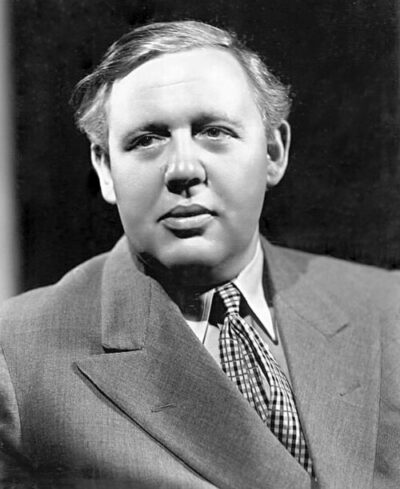
Charles Laughton
Charles Laughton was a British-American actor. Born July 1, 1899, in Scarborough. Died December 15, 1962, in Hollywood. Known for The Night of the Hunter. Educated at Royal Academy of Dramatic Art and Scarborough College. Awards include Academy Award for Best Actor, Grammy Award for Best Audio Book, Narration & Storytelling Recording and star on Hollywood Walk of Fame.
Facts
28 facts · 2 confirmed by two sources · 9 cited · 17 from one source
Where this comes from
Papalocal keeps its own record. It started from these sources; what each one said is kept here as it was copied, so a change on their side never changes this page by itself. Tap one to read its version.
What Wikidata says · copied November 13, 2026 · revision 2568906570
- Described as
- British-American actor (1899–1962)
- Born
- July 1, 1899 · 11 references
- Died
- December 15, 1962 · 11 references
- Born in
- Scarborough · 1 reference
- Died in
- Hollywood · 2 references
- Buried in
- Forest Lawn Memorial Park
- Cause of death
- kidney cancer
- Citizen of
- United Kingdom · 1 reference; United States
- Occupation
- theatre director; film director; film actor · 1 reference; stage actor; actor · 3 references; television actor; director · 3 references; film screenwriter
- Education
- Royal Academy of Dramatic Art (–1926) · 1 reference; Scarborough College
- Record label
- RCA Victor
- Known for
- The Night of the Hunter · 1 reference
- Awards
- Academy Award for Best Actor (1934) · 1 reference; Grammy Award for Best Audio Book, Narration & Storytelling Recording (1962); star on Hollywood Walk of Fame · 1 reference; David di Donatello for Best Foreign Actor
- Spouse
- Elsa Lanchester (1929–1962) · 1 reference
- Religion
- atheism
- Military branch
- British Army
- Height
- 1.72 m (5 ft 8 in)
- Wikipedias with a page
- 66
Wikidata item Q55264 (wikidata.org/wiki/Q55264), public domain (CC0). Copied November 13, 2026.
What Wikipedia says · copied November 13, 2026 · revision 1385238071
Charles Laughton (; 1 July 1899 – 15 December 1962) was an English actor and director. Over his career he received an Academy Award and a Grammy Award as well as nominations for two BAFTAs and a Golden Globe. He earned a motion picture star on the Hollywood Walk of Fame in 1960.
Born in the North Riding of Yorkshire, Laughton was trained in London at the Royal Academy of Dramatic Art and first appeared professionally on the stage in 1926. He played a wide range of classical and modern roles both on West End and Off West End, making an impact in Shakespeare at the Old Vic. His acting career took him to Broadway and then Hollywood, where he portrayed everything from monsters and misfits to kings. He earned the Academy Award for Best Actor for his portrayal of the title character in the historical drama The Private Life of Henry VIII (1933).
Laughton was further Oscar-nominated for his roles as Captain William Bligh in the action adventure Mutiny on the Bounty (1935) and an irascible barrister in the courtroom drama Witness for the Prosecution (1957). Among his biggest film hits were The Barretts of Wimpole Street (1934), Ruggles of Red Gap (1935), Rembrandt (1936), Jamaica Inn (1939), The Hunchback of Notre Dame (1939), The Big Clock (1948), Young Bess (1953), Hobson's Choice (1954) and Spartacus (1960). His final film role was in Advise & Consent (1962).
He directed one film, the acclaimed thriller The Night of the Hunter (1955). In his later career, Laughton took up stage directing, notably in the dramas The Caine Mutiny Court-Martial, and Don Juan in Hell, in which he also starred.
- Born, in its opening lines
- July 1, 1899
- Died, in its opening lines
- December 15, 1962
From the Wikipedia article “Charles Laughton” (en.wikipedia.org/wiki/Charles_Laughton), by its contributors, under CC BY-SA 4.0 (creativecommons.org/licenses/by-sa/4.0/). Copied November 13, 2026; not changed.
Confirmed Two sources agree. Cited One source, and it names where it got it. One source One source, without a reference of its own. Sources disagree The sources disagree. We show the best-supported value and keep theirs below.
