
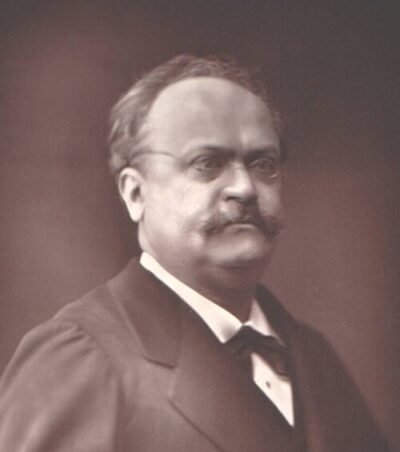
Charles Lecocq
Charles Lecocq was a French composer. Born June 3, 1832, in Paris. Died October 24, 1918, in Paris. Educated at Conservatoire de Paris. Awards include Officer of the Legion of Honour.
Facts
11 facts · 2 confirmed by two sources · 4 cited · 4 from one source · 1 where the sources disagree
What’s different
- Buried in: we show Père Lachaise Cemetery (Sources disagree). Wikidata also lists Grave of Lecocq
Where this comes from
Papalocal keeps its own record. It started from these sources; what each one said is kept here as it was copied, so a change on their side never changes this page by itself. Tap one to read its version.
What Wikidata says · copied November 18, 2026 · revision 2557837696
- Described as
- French composer (1832–1918)
- Other names
- Alexandre Charles Lecocq
- Born
- June 3, 1832 · 11 references
- Died
- October 24, 1918 · 11 references
- Born in
- Paris · 4 references
- Died in
- Paris · 4 references
- Buried in
- Père Lachaise Cemetery; Grave of Lecocq
- Citizen of
- France
- Occupation
- composer · 1 reference
- Education
- Conservatoire de Paris
- Genre
- opera
- Instrument
- piano
- Awards
- Officer of the Legion of Honour (1913) · 1 reference
- Wikipedias with a page
- 21
Wikidata item Q538894 (wikidata.org/wiki/Q538894), public domain (CC0). Copied November 18, 2026.
What Wikipedia says · copied November 18, 2026 · revision 1349918462
Alexandre Charles Lecocq (French pronunciation: [alɛksɑ̃dʁ ʃaʁl ləkɔk]; 3 June 1832 – 24 October 1918) was a French composer, known for his opérettes and opéras comiques. He became the most prominent successor to Jacques Offenbach in this sphere, and enjoyed considerable success in the 1870s and early 1880s, before the changing musical fashions of the late 19th century made his style of composition less popular. His few serious works include the opera Plutus (1886), which was not a success, and the ballet Le Cygne (1899). His only piece to survive in the regular modern operatic repertory is his 1872 opéra comique La Fille de Madame Angot (Mme Angot's Daughter). Others of his more than forty stage works receive occasional revivals.
After study at the Paris Conservatoire, Lecocq shared the first prize with Georges Bizet in an operetta-writing contest organised in 1856 by Offenbach. Lecocq's next successful composition was an opéra-bouffe, Fleur-de-Thé (Tea-flower), twelve years later. His comic operas Les Cent Vierges (The Hundred Virgins, 1872), La Fille de Madame Angot (1872) and Giroflé-Girofla (1874) were all successes and established his international reputation. Critics remarked on the elegance of the music in Lecocq's best works. His other popular pieces in the 1870s included La Petite Mariée (The Little Bride, 1875) and Le Petit Duc (The Little Duke, 1878). Although a few of his works in the early 1880s were well-received, and he continued composing for more than two decades afterwards, his later works never achieved the same admiration.
- Born, in its opening lines
- June 3, 1832
- Died, in its opening lines
- October 24, 1918
From the Wikipedia article “Charles Lecocq” (en.wikipedia.org/wiki/Charles_Lecocq), by its contributors, under CC BY-SA 4.0 (creativecommons.org/licenses/by-sa/4.0/). Copied November 18, 2026; not changed.
Confirmed Two sources agree. Cited One source, and it names where it got it. One source One source, without a reference of its own. Sources disagree The sources disagree. We show the best-supported value and keep theirs below.
