
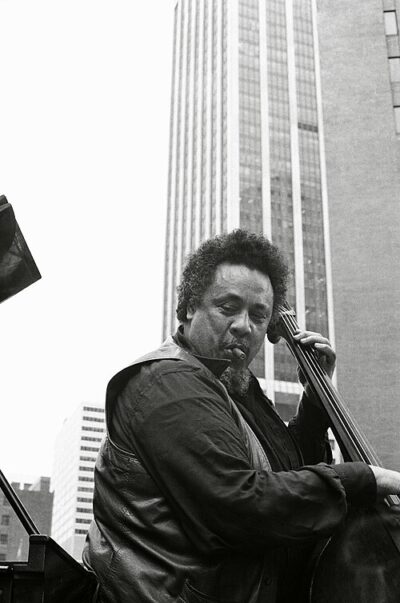
Charles Mingus
Charles Mingus was an American jazz double bassist, composer and bandleader. Born April 22, 1922, in Nogales. Died January 5, 1979, in Cuernavaca. Educated at Jordan High School. Awards include Guggenheim Fellowship, Grammy Lifetime Achievement Award (2 times) and Grammy Hall of Fame (3 times).
Facts
49 facts · 2 confirmed by two sources · 19 cited · 28 from one source
Where this comes from
Papalocal keeps its own record. It started from these sources; what each one said is kept here as it was copied, so a change on their side never changes this page by itself. Tap one to read its version.
What Wikipedia says · copied November 13, 2026 · revision 1384320442
Charles Mingus Jr. (April 22, 1922 – January 5, 1979) was an American jazz upright bassist, composer, bandleader, pianist, and author. A major proponent of collective improvisation, he is considered one of the greatest jazz musicians and composers in history, with a career spanning three decades and collaborations with other jazz greats, such as Duke Ellington, Charlie Parker, Max Roach, and Eric Dolphy. Mingus's work ranged from advanced bebop and avant-garde jazz with small and midsize ensembles to pioneering the post-bop style on seminal recordings like Pithecanthropus Erectus (1956) and Mingus Ah Um (1959) and progressive big band experiments such as The Black Saint and the Sinner Lady (1963).
Mingus's compositions continue to be played by contemporary musicians ranging from the repertory bands Mingus Big Band, Mingus Dynasty, and Mingus Orchestra to high school students who play the charts and compete in the Charles Mingus High School Competition. In 1993, the Library of Congress acquired Mingus's collected papers—including scores, sound recordings, correspondence, and photos—in what it called "the most important acquisition of a manuscript collection relating to jazz in the Library's history".
- Born, in its opening lines
- April 22, 1922
- Died, in its opening lines
- January 5, 1979
From the Wikipedia article “Charles Mingus” (en.wikipedia.org/wiki/Charles_Mingus), by its contributors, under CC BY-SA 4.0 (creativecommons.org/licenses/by-sa/4.0/). Copied November 13, 2026; not changed.
What Wikidata says · copied November 14, 2026 · revision 2569171201
- Described as
- American jazz double bassist, composer and bandleader (1922–1979)
- Other names
- Charlie Mingus, Charles Mingus Jr., Charles Baron Mingus
- Born
- April 22, 1922 · 10 references
- Died
- January 5, 1979 · 11 references
- Born in
- Nogales · 5 references
- Died in
- Cuernavaca · 5 references
- Cause of death
- amyotrophic lateral sclerosis · 1 reference
- Citizen of
- United States · 2 references
- Occupation
- pianist · 1 reference; composer · 4 references; bandleader · 3 references; conductor; jazz musician · 1 reference; bassist · 2 references; musician · 1 reference; double-bassist · 1 reference
- Worked for
- University at Buffalo
- Education
- Jordan High School
- Member of
- The Charles Mingus Quintet; Charles Mingus Jazz Workshop; Jazz Artists Guild; Charles Mingus Sextet; Charles Mingus Octet
- Genre
- jazz; bebop · 1 reference; post-bop · 1 reference; gospel music; hard bop · 1 reference; free jazz · 1 reference
- Instrument
- piano; double bass · 1 reference; trombone; cello
- Record label
- Debut Records; United Artists Records; Impulse!; Columbia Records; Mercury Records; Blue Note
- Awards
- Guggenheim Fellowship (1971) · 1 reference; Grammy Lifetime Achievement Award (2 times) (1996, 1997); Grammy Hall of Fame (3 times) (1994, 1998, 2013)
- Spouse
- Sue Mingus (–1979); Celia Germanis · 1 reference
- Children
- Eric Mingus · 1 reference; Charles Mingus III
- Religion
- Hinduism
- Lived in
- New York; Arizona · 1 reference; Cuernavaca (–1979)
- Website
- https://www.charlesmingus.com
- Wikipedias with a page
- 49
Wikidata item Q107432 (wikidata.org/wiki/Q107432), public domain (CC0). Copied November 14, 2026.
Confirmed Two sources agree. Cited One source, and it names where it got it. One source One source, without a reference of its own. Sources disagree The sources disagree. We show the best-supported value and keep theirs below.
