
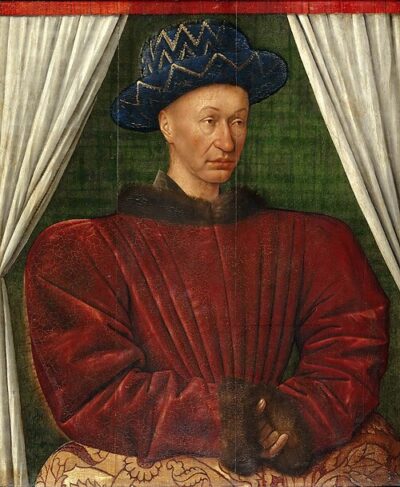
Charles VII of France
Charles VII of France was a monarch of the House of Valois who ruled as King of France. Born February 22, 1403, in Paris. Died July 22, 1461, in Mehun-sur-Yèvre. Positions held include King of France (1422–1461). Awards include Golden Rose.
Facts
39 facts · 2 confirmed by two sources · 17 cited · 20 from one source
Where this comes from
Papalocal keeps its own record. It started from these sources; what each one said is kept here as it was copied, so a change on their side never changes this page by itself. Tap one to read its version.
What Wikidata says · copied November 16, 2026 · revision 2567871087
- Described as
- monarch of the House of Valois who ruled as King of France (1403-1461)
- Other names
- Charles VII, Charles VII the Victorious, Charles VII, the Victorious
- Born
- February 22, 1403 · 1 reference
- Died
- July 22, 1461 · 1 reference
- Born in
- Paris · 1 reference
- Died in
- Mehun-sur-Yèvre · 1 reference
- Buried in
- Basilica of Saint-Denis
- Citizen of
- France
- Occupation
- sovereign; monarch; mint lord · 1 reference
- Positions held
- King of France (1422–1461) · 3 references
- Awards
- Golden Rose
- Spouse
- Marie of Anjou (1422–1461) · 2 references
- Children
- Louis XI of France · 1 reference; Catherine of France, Countess of Charolais · 1 reference; Yolande of Valois; Joan of Valois, Duchess of Bourbon; Magdalena of Valois · 1 reference; Charles de Valois, Duc de Berry; Charlotte de France; Radegonde de France; Marie de France; Marie de Valois · 1 reference; Jean de France · 1 reference; Jacques de France · 1 reference
- Father
- Charles VI of France · 1 reference
- Mother
- Isabeau of Bavaria · 1 reference
- Siblings
- Marie, Prioress of Poissy; Catherine of Valois · 1 reference; Isabella of Valois · 1 reference; Michelle of Valois · 1 reference; Joan of France, Duchess of Brittany; Marguerite, bâtarde de France; Louis, Dauphin of France, Duke of Guyenne; John, Dauphin of France, Duke of Touraine · 1 reference
- Religion
- Christianity
- Lived in
- Chinon; Loches; Bourges; Mehun-sur-Yèvre
- Wikipedias with a page
- 78
Wikidata item Q133372 (wikidata.org/wiki/Q133372), public domain (CC0). Copied November 16, 2026.
What Wikipedia says · copied November 16, 2026 · revision 1384083830
Charles VII (22 February 1403 – 22 July 1461), called the Victorious (French: le Victorieux) or the Well-Served (le Bien-Servi), was King of France from 1422 to his death in 1461. His reign saw the end of the Hundred Years' War and a de facto end of the English claims to the French throne.
During the Hundred Years' War, Charles VII inherited the throne of France under desperate circumstances. Forces of the Kingdom of England and the duke of Burgundy occupied Guyenne and northern France, including Paris, the capital and most populous city, and Reims, the city in which French kings were traditionally crowned. In addition, his father, Charles VI, had disinherited him in 1420 and recognized Henry V of England and his heirs as the legitimate successors to the French crown. At the same time, a civil war raged in France between the Armagnacs (supporters of the House of Valois) and the Burgundian party (supporters of the House of Valois-Burgundy, which was allied to the English).
With his court removed to Bourges, south of the Loire river, Charles was disparagingly called the "King of Bourges", because the area around this city was one of the few remaining regions left to him. However, his political and military position improved dramatically with the emergence of Joan of Arc as a spiritual leader in France. Joan and Jean de Dunois led French troops to lift the siege of Orléans and other besieged strategic cities on the Loire river, and to defeat the English at the Battle of Patay. With local English troops dispersed, the people of Reims switched allegiance and opened their gates, which enabled Charles VII to be crowned at Reims Cathedral in 1429. Six years later, he ended the Anglo-Burgundian alliance by signing the Treaty of Arras with Burgundy, followed by the recovery of Paris in 1436 and the steady reconquest of Normandy in the 1440s using a newly organized professional army and advanced siege cannons. Following the Battle of Castillon in 1453, the French recaptured all of England's continental possessions except the Pale of Calais.
The last years of Charles VII were marked by conflicts with his turbulent son, the future Louis XI.
- Born, in its opening lines
- February 22, 1403
- Died, in its opening lines
- July 22, 1461
From the Wikipedia article “Charles VII of France” (en.wikipedia.org/wiki/Charles_VII_of_France), by its contributors, under CC BY-SA 4.0 (creativecommons.org/licenses/by-sa/4.0/). Copied November 16, 2026; not changed.
Confirmed Two sources agree. Cited One source, and it names where it got it. One source One source, without a reference of its own. Sources disagree The sources disagree. We show the best-supported value and keep theirs below.
