
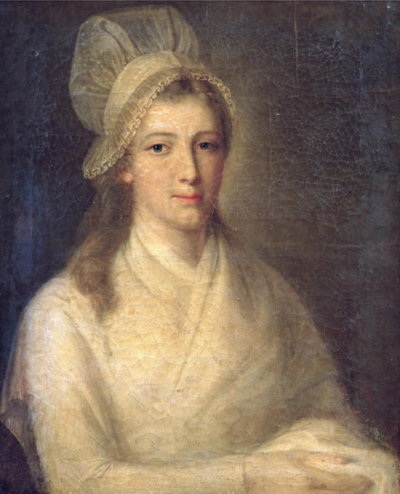
Charlotte Corday
Charlotte Corday was a figure of the French Revolution. Born July 27, 1768, in Ligneries. Died July 17, 1793, in place de la Concorde.
Facts
10 facts · 2 confirmed by two sources · 1 cited · 7 from one source
Where this comes from
Papalocal keeps its own record. It started from these sources; what each one said is kept here as it was copied, so a change on their side never changes this page by itself. Tap one to read its version.
What Wikidata says · copied November 16, 2026 · revision 2557839112
- Described as
- figure of the French Revolution (1768-1793)
- Other names
- Marie-Anne Charlotte de Corday d'Armont, Marie Anne Charlotte de Corday d'Armont, CharlotteRepublikanerin
- Born
- July 27, 1768 · 11 references
- Died
- July 17, 1793 · 10 references
- Born in
- Ligneries · 1 reference
- Died in
- place de la Concorde
- Buried in
- Madeleine Cemetery
- Cause of death
- decapitation by guillotine
- Name at birth
- Marie-Anne Charlotte de Corday d'Armont
- Citizen of
- France
- Occupation
- aristocrat
- Religion
- Catholicism
- Wikipedias with a page
- 57
Wikidata item Q216063 (wikidata.org/wiki/Q216063), public domain (CC0). Copied November 16, 2026.
What Wikipedia says · copied November 16, 2026 · revision 1382837402
Marie-Anne Charlotte de Corday d'Armont (27 July 1768 – 17 July 1793), known as Charlotte Corday (French: [kɔʁdɛ]), was a figure of the French Revolution who assassinated revolutionary and Jacobin leader Jean-Paul Marat on 13 July 1793. Corday was an aristocratic sympathiser of the Girondins, a moderate faction of French revolutionaries in opposition to the more extremist Jacobins. She held Marat responsible for the September Massacres of 1792 and, believing that the Revolution was in jeopardy from the more radical course the Jacobins had taken, she decided to assassinate Marat.
On 13 July 1793, having travelled to Paris and obtained an audience with Marat, Corday fatally stabbed him with a knife while he was taking a medicinal bath. Marat's assassination was memorialised in the painting The Death of Marat by Jacques-Louis David. Corday was immediately arrested, found guilty by the Revolutionary Tribunal and on 17 July, four days after Marat's death, executed by the guillotine on the Place de Grève.
The direct consequences of the assassination were the opposite of what she expected: the assassination did not stop the Jacobins or the Reign of Terror, which intensified after the murder. Marat became a martyr, a bust of him replaced a religious statue on the rue aux Ours, and several place-names were changed to honour Marat. In 1847, writer Alphonse de Lamartine gave Corday the posthumous nickname l'ange de l'assassinat (the Angel of Assassination).
- Born, in its opening lines
- July 27, 1768
- Died, in its opening lines
- July 17, 1793
From the Wikipedia article “Charlotte Corday” (en.wikipedia.org/wiki/Charlotte_Corday), by its contributors, under CC BY-SA 4.0 (creativecommons.org/licenses/by-sa/4.0/). Copied November 16, 2026; not changed.
Confirmed Two sources agree. Cited One source, and it names where it got it. One source One source, without a reference of its own. Sources disagree The sources disagree. We show the best-supported value and keep theirs below.
