
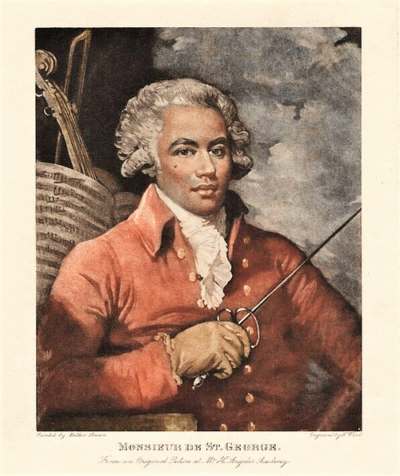
Chevalier de Saint-Georges
Chevalier de Saint-Georges was a French virtuoso violinist, composer, conductor, and fencing master. Born December 25, 1745, in Baillif. Died June 10, 1799, in Paris. Known for Nous sommes donc trois ? ou le Provincial à Paris.
Facts
25 facts · 1 confirmed by two sources · 18 cited · 5 from one source · 1 where the sources disagree
What’s different
- Died: we show June 10, 1799 (Sources disagree). Wikipedia says June 9, 1799
Where this comes from
Papalocal keeps its own record. It started from these sources; what each one said is kept here as it was copied, so a change on their side never changes this page by itself. Tap one to read its version.
What Wikidata says · copied November 17, 2026 · revision 2551864905
- Described as
- French virtuoso violinist, composer, conductor, and fencing master
- Other names
- Joseph Bologne de Saint Georges, Saint-Georges (Joseph Bologne de), Joseph Boulogne, Chevalier De Saint-Georges
- Born
- December 25, 1745 · 5 references
- Died
- June 10, 1799 · 3 references
- Born in
- Baillif · 1 reference
- Died in
- Paris · 1 reference
- Cause of death
- gangrene · 1 reference
- Citizen of
- France
- Occupation
- composer · 1 reference; conductor · 1 reference; fencer · 1 reference; concertmaster · 2 references; military personnel · 1 reference; violinist · 1 reference
- Worked for
- Concert des Amateurs (1771) · 1 reference
- Sport
- fencing · 1 reference
- Instrument
- violin · 1 reference
- Known for
- Nous sommes donc trois ? ou le Provincial à Paris
- Field
- classical music · 1 reference; opera · 1 reference; concerto · 1 reference; chamber music · 1 reference; symphonic music · 1 reference; conducting
- Father
- Georges de Bologne Saint-Georges
- Military branch
- Army of the North
- Military rank
- colonel (1792–) · 2 references
- Wikipedias with a page
- 26
Wikidata item Q726953 (wikidata.org/wiki/Q726953), public domain (CC0). Copied November 17, 2026.
What Wikipedia says · copied November 17, 2026 · revision 1385897846
Joseph Bologne, Chevalier de Saint-George(s) (; French: [ʒozɛf bɔlɔɲ]; 25 December 1745 – 9 June 1799) was a French violinist, conductor, composer, and soldier of African descent. Moreover, he demonstrated excellence as a fencer, an athlete, and a dancer. His historical significance lies partly in his distinctive background as a biracial free man of colour. Bologne was the first classical composer of African descent to attain widespread acclaim in Western music. He composed an array of violin concertos, string quartets, sinfonia concertantes, violin duets, sonatas, two symphonies, and an assortment of stage works, notably opéra comique.
Born in the French colony of Guadeloupe, his father, Georges Bologne de Saint-Georges, was a wealthy, white Plantation owner, while his mother was one of the Senegalese people Georges kept enslaved. At the age of seven, he was taken to France where he began his formal education. As a young man he won a fencing contest leading to his appointment as a “gendarme de la garde du roi" by king Louis XVI. Having received music and musical composition lessons, he joined the orchestra Le Concert des Amateurs, culminating in his appointment as its conductor in 1773.
In 1776, Saint-Georges began conducting the Paris Opera. However, this prospect was thwarted by opposition from certain performers who resisted the idea of an individual of colour directing them. Around this time, he shifted his focus to composing operas. In 1781, he joined a new orchestra, Le Concert de la Loge Olympique. By 1785, he had stopped composing instrumental works altogether.
Following the outbreak of the French Revolution in 1789, Saint-Georges left for England. Upon his return to France, he joined the National Guard in Lille and then served as a colonel in the Légion St.-Georges, which comprised "citizens of colour". His social and professional ties to prominent figures such as Marie Antoinette and the Duke of Orléans made him a target of the Reign of Terror, culminating in a period of imprisonment spanning at least eleven months.
Saint-Georges, a contemporary of Mozart, has at times been called the "Black Mozart." Some have criticized this appellation as racist and a reductive description of his own musical ability, but others have used it to champion Saint-Georges. The violinist Randall Goosby said, "I prefer to think of Mozart as the white Chevalier."
- Born, in its opening lines
- December 25, 1745
- Died, in its opening lines
- June 9, 1799
From the Wikipedia article “Chevalier de Saint-Georges” (en.wikipedia.org/wiki/Chevalier_de_Saint-Georges), by its contributors, under CC BY-SA 4.0 (creativecommons.org/licenses/by-sa/4.0/). Copied November 17, 2026; not changed.
Confirmed Two sources agree. Cited One source, and it names where it got it. One source One source, without a reference of its own. Sources disagree The sources disagree. We show the best-supported value and keep theirs below.
