
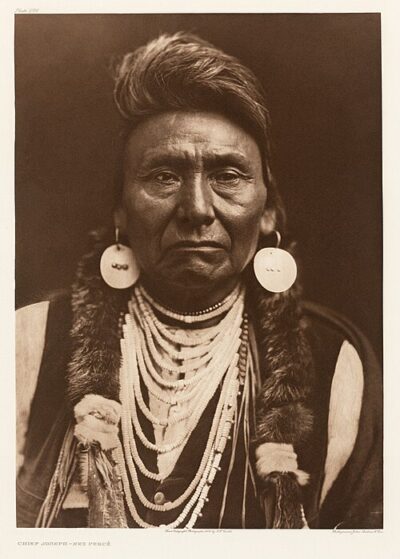
Chief Joseph
Chief Joseph was the 19th-century Native American leader. Born March 3, 1840, in Wallowa River. Died September 21, 1904, in Colville Indian Reservation.
Facts
9 facts · 2 confirmed by two sources · 3 cited · 4 from one source
Where this comes from
Papalocal keeps its own record. It started from these sources; what each one said is kept here as it was copied, so a change on their side never changes this page by itself. Tap one to read its version.
What Wikidata says · copied November 15, 2026 · revision 2567403649
- Described as
- 19th-century Native American leader
- Other names
- Joseph Buruzagia, Hinmatóowyalahtq’it, Hin-mut-too-uah-lat-kekht, Thunder Rolling in the Mountains, Joseph the Younger, Heinmot Tooyalaket
- Born
- March 3, 1840 · 2 references
- Died
- September 21, 1904 · 5 references
- Born in
- Wallowa River · 1 reference
- Died in
- Colville Indian Reservation
- Buried in
- Nez Perce Cemetery · 1 reference
- Citizen of
- United States
- Occupation
- traditional leader or chief · 1 reference
- Father
- Old Chief Joseph
- Siblings
- Ollokot
- Wikipedias with a page
- 32
Wikidata item Q453666 (wikidata.org/wiki/Q453666), public domain (CC0). Copied November 15, 2026.
What Wikipedia says · copied November 15, 2026 · revision 1383589348
Hin-mah-too-yah-lat-kekt or hinmatóowyalahtq̓it, "Thunder Rolling Down the Mountain" (March 3, 1840 – September 21, 1904), popularly known as Chief Joseph, Young Joseph, or Joseph the Younger, was a leader of the wal-lam-wat-kain (Wallowa) band of Nez Perce, a Native American tribe of the interior Pacific Northwest region of the United States, in the latter half of the 19th century. He succeeded his father Tuekakas (Chief Joseph the Elder) in the early 1870s.
Chief Joseph led his band of Nez Perce during the most tumultuous period in their history, when they were forcibly removed by the United States federal government from their ancestral lands in the Wallowa Valley of northeastern Oregon onto a significantly reduced reservation in the Idaho Territory. A series of violent encounters with white settlers in the spring of 1877 culminated in those Nez Perce who resisted removal, including Joseph's band and an allied band of the Palouse tribe, fleeing the United States in an attempt to reach political asylum alongside the Lakota people, who had sought refuge in Canada under the leadership of Sitting Bull.
At least 800 men, women, and children led by Joseph and other Nez Perce chiefs were pursued by the U.S. Army under General Oliver O. Howard in a 1,170-mile (1,900 km) fighting retreat known as the Nez Perce War. The skill with which the Nez Perce fought and the manner in which they conducted themselves in the face of incredible adversity earned them widespread admiration from their military opponents and the American public, and coverage of the war in U.S. newspapers led to popular recognition of Chief Joseph and the Nez Perce.
In October 1877, after months of fugitive resistance, most of the surviving remnants of Joseph's band were cornered in northern Montana Territory, just 40 miles (64 km) from the Canadian border. Unable to fight any longer, Chief Joseph surrendered to the Army with the understanding that he and his people would be allowed to return to the reservation in western Idaho. He was instead transported between various forts and reservations on the southern Great Plains before being moved to the Colville Indian Reservation in the state of Washington, where he died in 1904.
- Born, in its opening lines
- March 3, 1840
- Died, in its opening lines
- September 21, 1904
From the Wikipedia article “Chief Joseph” (en.wikipedia.org/wiki/Chief_Joseph), by its contributors, under CC BY-SA 4.0 (creativecommons.org/licenses/by-sa/4.0/). Copied November 15, 2026; not changed.
Confirmed Two sources agree. Cited One source, and it names where it got it. One source One source, without a reference of its own. Sources disagree The sources disagree. We show the best-supported value and keep theirs below.
