
Childeric I
Childeric I was a Frankish king. Born 436. Died 481, in Tournai. Positions held include king of Franks (458–481).
Facts
12 facts · 0 confirmed by two sources · 10 cited · 2 from one source
Where this comes from
Papalocal keeps its own record. It started from these sources; what each one said is kept here as it was copied, so a change on their side never changes this page by itself. Tap one to read its version.
What Wikidata says · copied November 16, 2026 · revision 2557839671
- Described as
- Frankish king
- Other names
- Childéric I, Childericus I
- Born
- 436 · 2 references
- Died
- 481 · 4 references
- Died in
- Tournai · 1 reference
- Buried in
- Tournai
- Occupation
- monarch · 1 reference
- Positions held
- king of Franks (458–481)
- Spouse
- Basina of Thuringia · 1 reference
- Children
- Clovis I · 1 reference; Audofleda · 1 reference; Lantechildis · 1 reference; Albofledis · 1 reference
- Father
- Merovech · 1 reference
- Wikipedias with a page
- 55
Wikidata item Q193869 (wikidata.org/wiki/Q193869), public domain (CC0). Copied November 16, 2026.
What Wikipedia says · copied November 16, 2026 · revision 1383230034
Childeric I (died about 481/482 AD) was a 5th-century Frankish ruler in what is now northern France, during the period when this part of Roman Gaul became permanently disconnected from the central Roman government in 461, and the last emperor based in Italy was dethroned in 476. He is the ancestor of the early medieval Merovingian dynasty, and father of Clovis I, who would go on to acquire effective control over all or most of the small Frankish kingdoms of the time, and unite a significant part of formerly Roman Gaul under Frankish rule.
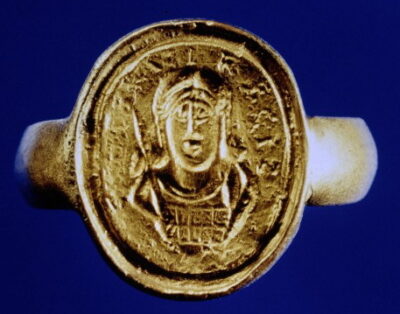
Childeric was described as a king (Latin: rex), both on his Roman-style seal ring, which was buried with him in Tournai, and in fragmentary later records of his life, but scholars have different interpretation of the term rex in northern Gaul in this period. He and the Frankish forces loyal to him seem to have coordinated with forces who fought in the name of Rome, during a period when Roman chains of command were no longer stable. According to a common, but not universally accepted interpretation of a letter written by Saint Remigius, Childeric, or at least one or more of the relatives (parentes) of Clovis, even held an official position within a Roman-style administration in northern Gaul. The family background of Childeric is uncertain but he was reputed to be a descendant of Chlodio, and as a leader of Frankish troops based within the Roman empire he may, like several Gaulish military leaders in his generation, have served when younger under the powerful Roman military leader and statesman Aëtius, who died in 454. His burial site, which has been discovered in Tournai in Belgium, contained a wide range of artefacts, including some which were Roman symbols of authority.
The only definitely near-contemporary source to mention him is the 6th-century History of the Franks of Gregory of Tours, which mentions him twice, once concerning a legend about him spending time in exile, and once in a compressed account of conflicts mainly near the river Loire, which at the time represented a zone of confrontation against the expanding power of the Visigoths in what is now southwestern France. Both of these passages associate Childeric with the Gallo-Roman general Aegidius. Two later works which drew upon Gregory also mention Childeric, the Chronicle of Fredegar, and the Liber Historiae Francorum. They are considered less reliable overall for this period, and many scholars believe they misunderstood Gregory by making Childeric and Aegidius competitors or enemies. However they added information which may reflect other sources which the authors had available. Another brief mention of Childeric which may derive from near-contemporary material is the medieval biography of Saint Genevieve of Paris, the Vita Genovefae. It mentions that Childeric had a great love for the saint, and it portrays him as someone who held military control of the countryside around the Paris region.
From the Wikipedia article “Childeric I” (en.wikipedia.org/wiki/Childeric_I), by its contributors, under CC BY-SA 4.0 (creativecommons.org/licenses/by-sa/4.0/). Copied November 16, 2026; not changed.
Confirmed Two sources agree. Cited One source, and it names where it got it. One source One source, without a reference of its own. Sources disagree The sources disagree. We show the best-supported value and keep theirs below.
