
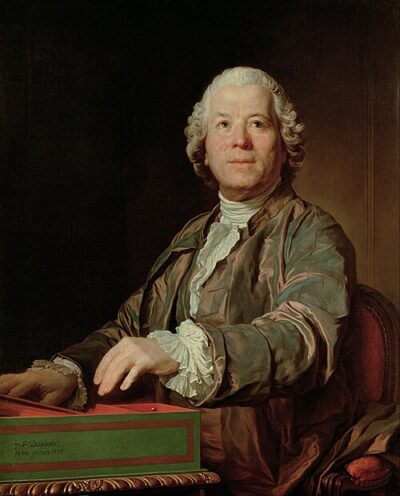
Christoph Willibald von Gluck
Christoph Willibald von Gluck was an opera composer. Born July 2, 1714, in Erasbach. Died November 15, 1787, in Vienna. Positions held include court chapel master. Known for Orfeo ed Euridice, Iphigénie en Tauride and Alceste. Educated at Charles University. Awards include Order of the Golden Spur.
Facts
28 facts · 2 confirmed by two sources · 11 cited · 15 from one source
Where this comes from
Papalocal keeps its own record. It started from these sources; what each one said is kept here as it was copied, so a change on their side never changes this page by itself. Tap one to read its version.
What Wikidata says · copied November 14, 2026 · revision 2568915186
- Described as
- opera composer (1714–1787)
- Other names
- Christoph Willibald Gluck, Christoph von Glück, Christoph Willibald Gluck, Ritter von, Christoph Willibald, Christoph Willibald Ritter von Gluck, Gluck
- Born
- July 2, 1714 · 17 references
- Died
- November 15, 1787 · 16 references
- Born in
- Erasbach · 2 references
- Died in
- Vienna · 9 references
- Buried in
- Vienna Central Cemetery
- Cause of death
- stroke
- Citizen of
- Kingdom of Bohemia · 1 reference; Archduchy of Austria · 1 reference
- Occupation
- composer · 2 references; conductor · 1 reference; photographer · 1 reference
- Positions held
- court chapel master
- Education
- Charles University
- Genre
- opera · 1 reference; classical music · 1 reference; ballet · 1 reference
- Instrument
- pipe organ · 1 reference
- Known for
- Orfeo ed Euridice; Iphigénie en Tauride; Alceste; Iphigénie en Aulide; Armide
- Awards
- Order of the Golden Spur
- Spouse
- Maria Anna Gluck
- Father
- Johannes Alexander Gluck · 1 reference
- Mother
- Maria Walburga Gluck
- Lived in
- Paris; Vienna
- Wikipedias with a page
- 82
Wikidata item Q130759 (wikidata.org/wiki/Q130759), public domain (CC0). Copied November 14, 2026.
What Wikipedia says · copied November 14, 2026 · revision 1376255801
Christoph Willibald Ritter von Gluck (; German: [ˈkʁɪstɔf ˈvɪlɪbalt ˈɡlʊk]; 2 July 1714 – 15 November 1787) was a composer of Italian and French opera in the early classical period. Born in the Upper Palatinate and raised in Bohemia, both part of the Holy Roman Empire at the time, he gained prominence at the Habsburg court in Vienna. There he brought about the practical reform of opera's dramaturgical practices for which many intellectuals had been campaigning. With a series of radical new works in the 1760s, among them Orfeo ed Euridice and Alceste, he broke the stranglehold that Metastasian opera seria had enjoyed for much of the century. Gluck introduced more drama by using orchestral recitative and cutting the usually long da capo aria. His later operas have half the length of a typical baroque opera.
The strong influence of French opera encouraged Gluck to move to Paris in November 1773. Fusing the traditions of Italian opera and the French (with rich chorus) into a unique synthesis, Gluck wrote eight operas for the Parisian stage. Iphigénie en Tauride (1779) was a great success and is often considered to be his finest work. Though he was extremely popular and widely credited with bringing about a revolution in French opera, Gluck's mastery of the Parisian operatic scene was never absolute. After the poor reception of his Echo et Narcisse (1779), he left Paris in disgust and returned to Vienna to live out the remainder of his life.
- Born, in its opening lines
- July 2, 1714
- Died, in its opening lines
- November 15, 1787
From the Wikipedia article “Christoph Willibald Gluck” (en.wikipedia.org/wiki/Christoph_Willibald_Gluck), by its contributors, under CC BY-SA 4.0 (creativecommons.org/licenses/by-sa/4.0/). Copied November 14, 2026; not changed.
Confirmed Two sources agree. Cited One source, and it names where it got it. One source One source, without a reference of its own. Sources disagree The sources disagree. We show the best-supported value and keep theirs below.
