
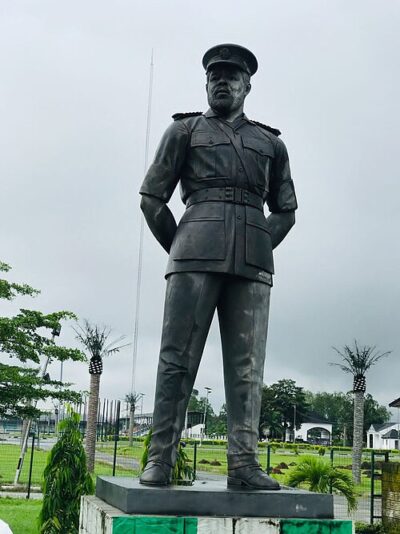
Chukwuemeka Odumegwu Ojukwu
Chukwuemeka Odumegwu Ojukwu was a nigerian politician and military leader. Born November 4, 1933, in Zungeru. Died November 26, 2011, in London. Known for Because I am involved. Educated at Epsom College and Lincoln College.
Facts
20 facts · 2 confirmed by two sources · 4 cited · 14 from one source
Where this comes from
Papalocal keeps its own record. It started from these sources; what each one said is kept here as it was copied, so a change on their side never changes this page by itself. Tap one to read its version.
What Wikidata says · copied November 16, 2026 · revision 2569009914
- Described as
- nigerian politician and military leader (1933-2011)
- Born
- November 4, 1933 · 5 references
- Died
- November 26, 2011 · 5 references
- Born in
- Zungeru · 1 reference
- Died in
- London · 1 reference
- Buried in
- Nigeria · 1 reference
- Cause of death
- disease
- Citizen of
- Nigeria
- Occupation
- politician · 1 reference; military personnel
- Political party
- National Party of Nigeria
- Education
- Epsom College; Lincoln College; Mons Officer Cadet School
- Known for
- Because I am involved · 1 reference
- Field
- military personnel · 1 reference; politician · 1 reference
- Spouse
- Bianca Odumegwu-Ojukwu
- Father
- Louis Odumegwu Ojukwu · 1 reference
- Religion
- Christianity
- Military rank
- Lieutenant Colonel
- Wikipedias with a page
- 32
Wikidata item Q380670 (wikidata.org/wiki/Q380670), public domain (CC0). Copied November 16, 2026.
What Wikipedia says · copied November 16, 2026 · revision 1383955406
Chukwuemeka Odumegwu Ojukwu (; 4 November 1933 – 26 November 2011) also known as Ikemba, was a Nigerian military officer and politician who served as President of Biafra from 1967 to 1970. As the military governor of the Eastern Region of Nigeria, which he declared as the independent state of Biafra, Ojukwu led the Biafran forces during the Nigerian Civil War against the Nigerian government forces.
Born in Zungeru, British Nigeria to Louis Odumegwu Ojukwu, a wealthy Igbo businessman, Ojukwu was educated at King's College, Lagos and Epsom College in Surrey, England. He proceeded to Lincoln College, Oxford University where he obtained a master's degree in Modern History in 1955. He returned to Nigeria to serve as an administrative officer and would later join the Nigerian army. Following the independence of Nigeria in 1960, a group of military officers overthrew Nigeria's civilian government in the 1966 Nigerian coup d'état and Johnson Aguiyi-Ironsi became the head of state. Ironsi appointed Ojukwu as military governor of the Eastern Region mostly dominated by the Igbo tribe.
In response to the demands of the protection of the Igbos in the then-Eastern region from being killed in several parts of the country - particularly the Northern parts of Nigeria, Ojukwu reorganised the Eastern Region as the Republic of Biafra, and he declared independence from Nigeria. Nigeria invaded Biafra, sparking the Nigerian Civil War which has been argued in many quarters as a genocide against the Igbos of the then-Eastern region. The Nigerian military, with support from the United Kingdom and the Soviet Union, blockaded Biafra and cut food supplies, which created a mass famine. Ojukwu made use of foreign media to highlight the plight of Biafran civilians and depict the war as genocide against Igbos. The shocking images of starving Biafran civilians turned the war into an international media sensation, as this was one of the first globally televised wars alongside the Vietnam War. Biafra received international humanitarian relief during the Biafran airlift.
Biafra eventually capitulated to Nigerian forces in 1970 after millions of Biafran civilians died. Ojukwu subsequently fled to Ivory Coast in exile, where President Félix Houphouët-Boigny, who recognised Biafra as a sovereign and independent state, granted him political asylum. In 1981, newly democratically elected Nigerian president Shehu Shagari granted amnesty to Ojukwu, allowing him to return to Nigeria without facing political or legal consequences from the war. Ojukwu spent the remainder of his life unsuccessfully attempting to return to Nigerian politics as a democratically elected politician rather than a military ruler.
He died in 2011 at the age of 78 in London, England. His body was returned to Nigeria, where Nigerian president Goodluck Jonathan arranged a state funeral. He was buried with full military honours, including a 21-gun salute from the Nigerian Army, and thousands of people attended his funeral. Ojukwu remains a contentious figure in the history of Nigeria. Many Igbo people regard him as a hero and a messianic figure who did what was necessary to ensure the survival of Nigeria's Eastern population while facing the possibility of a genocide after the 1966 coup. Other Nigerians have deemed Biafra's secession unnecessary, blaming Ojukwu for the events of the war and accusing him of oppressing Biafra's non-Igbo ethnic minorities.
- Born, in its opening lines
- November 4, 1933
- Died, in its opening lines
- November 26, 2011
From the Wikipedia article “Chukwuemeka Odumegwu Ojukwu” (en.wikipedia.org/wiki/Chukwuemeka_Odumegwu_Ojukwu), by its contributors, under CC BY-SA 4.0 (creativecommons.org/licenses/by-sa/4.0/). Copied November 16, 2026; not changed.
Confirmed Two sources agree. Cited One source, and it names where it got it. One source One source, without a reference of its own. Sources disagree The sources disagree. We show the best-supported value and keep theirs below.
