
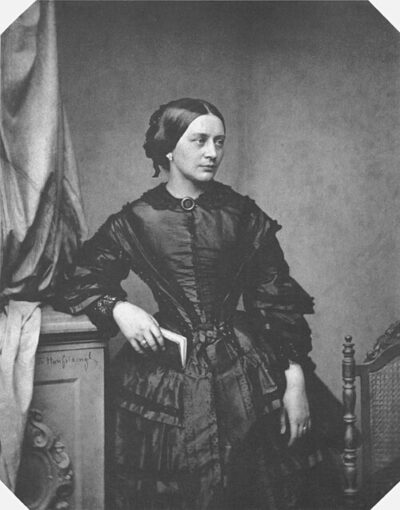
Clara Schumann
Clara Schumann was a German musician and composer. Born September 13, 1819, in Leipzig. Died May 20, 1896, in Frankfurt. Known for Piano Concerto No. 1 and Piano Trio.
Facts
37 facts · 2 confirmed by two sources · 20 cited · 15 from one source
Where this comes from
Papalocal keeps its own record. It started from these sources; what each one said is kept here as it was copied, so a change on their side never changes this page by itself. Tap one to read its version.
What Wikidata says · copied November 16, 2026 · revision 2570102253
- Described as
- German musician and composer (1819–1896)
- Other names
- Clara Wieck, Clara Wieck Schumann, Clara Josephine Schumann, Clara Josephine Wieck
- Born
- September 13, 1819 · 10 references
- Died
- May 20, 1896 · 10 references
- Born in
- Leipzig · 2 references
- Died in
- Frankfurt · 2 references
- Buried in
- La Guaira · 1 reference
- Cause of death
- stroke
- Name at birth
- Clara Josephine Wieck
- Citizen of
- Kingdom of Saxony
- Occupation
- pianist · 1 reference; composer · 3 references; music educator; editor · 1 reference; music arranger · 1 reference; piano teacher · 1 reference
- Worked for
- Hoch Conservatory
- Genre
- Romantic music · 1 reference
- Instrument
- piano
- Known for
- Piano Concerto No. 1; Piano Trio
- Spouse
- Robert Schumann (1840–1856) · 1 reference
- Children
- Eugenie Schumann · 1 reference; Felix Schumann · 1 reference; Julie Schumann · 1 reference; Marie Schumann · 1 reference; Ferdinand Schumann · 1 reference; Elise Schumann · 1 reference; Emil Schumann; Ludwig Schumann · 1 reference
- Father
- Friedrich Wieck · 1 reference
- Mother
- Mariane Bargiel · 1 reference
- Siblings
- Marie Wieck · 1 reference; Woldemar Bargiel · 2 references; Alwin Wieck · 1 reference; Gustav Wieck · 1 reference; Cäcilie Bargiel · 1 reference; Eugen Bargiel · 1 reference; Clementine Bargiel · 1 reference
- Wikipedias with a page
- 82
Wikidata item Q132232 (wikidata.org/wiki/Q132232), public domain (CC0). Copied November 16, 2026.
What Wikipedia says · copied November 16, 2026 · revision 1385633763
Clara Josephine Schumann (; German: [ˈklaːʁa jozəˈfiːnə ˈʃuːman]; née Wieck; 13 September 1819 – 20 May 1896) was a German virtuoso pianist, composer, and piano teacher. Regarded as one of the most distinguished pianists of the Romantic era, she exerted her influence over the course of a 61-year concert career, changing the format and repertoire of the piano recital by lessening the importance of purely virtuosic works. She also composed solo piano pieces, a piano concerto, chamber music, choral pieces, and songs.
She grew up in Leipzig, where both her father Friedrich Wieck and her mother Mariane were pianists and piano teachers. In addition, her mother was a singer. Clara was a child prodigy, and was trained by her father. She began touring at age eleven, and was successful in Paris and Vienna, among other cities. She married the composer Robert Schumann, on 12 September 1840, and the couple had eight children. Together, they encouraged Johannes Brahms and maintained a close relationship with him. She gave the public premieres of many works by her husband and by Brahms.
After Robert Schumann's early death, she continued her concert tours in Europe for decades, frequently with the violinist Joseph Joachim and other chamber musicians. Beginning in 1878, she was an influential piano educator at Dr. Hoch's Konservatorium in Frankfurt, where she attracted international students. She also edited the publication of her husband's work. Schumann died in Frankfurt, but was buried in Bonn beside her husband.
Several films have focused on Schumann's life, the earliest being Träumerei (Dreaming) of 1944. A 2008 film, Geliebte Clara (Beloved Clara), was directed by Helma Sanders-Brahms. An image of Clara Schumann from an 1835 lithograph by Andreas Staub was featured on the 100 Deutsche Mark banknote from 1989 to 2002. Interest in her compositions began to revive in the late 20th century, and her 2019 bicentenary prompted new books and exhibitions.
- Born, in its opening lines
- September 13, 1819
- Died, in its opening lines
- May 20, 1896
From the Wikipedia article “Clara Schumann” (en.wikipedia.org/wiki/Clara_Schumann), by its contributors, under CC BY-SA 4.0 (creativecommons.org/licenses/by-sa/4.0/). Copied November 16, 2026; not changed.
Confirmed Two sources agree. Cited One source, and it names where it got it. One source One source, without a reference of its own. Sources disagree The sources disagree. We show the best-supported value and keep theirs below.
