
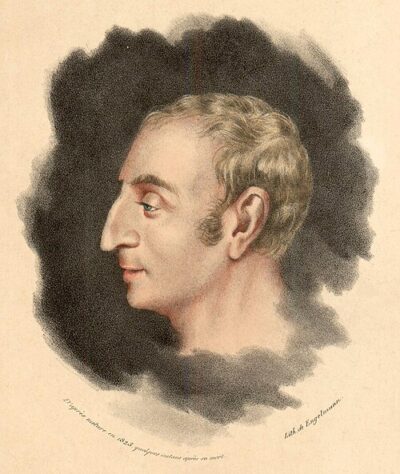
Claude Henri de Rouvroy, comte de Saint-Simon
Claude Henri de Rouvroy, comte de Saint-Simon was a French early socialist theorist. Born October 17, 1760, in Paris. Died May 19, 1825, in Paris.
Facts
18 facts · 2 confirmed by two sources · 4 cited · 11 from one source · 1 where the sources disagree
What’s different
- Died: we show May 19, 1825 (Confirmed). Wikidata also lists May 19, 1826
- Buried in: we show Père Lachaise Cemetery (Sources disagree). Wikidata also lists Grave of Claude Henri de Rouvroy de Saint-Simon
Where this comes from
Papalocal keeps its own record. It started from these sources; what each one said is kept here as it was copied, so a change on their side never changes this page by itself. Tap one to read its version.
What Wikidata says · copied November 16, 2026 · revision 2569062162
- Described as
- French early socialist theorist (1760-1825)
- Other names
- Henri de Saint-Simon, Claude Henri de Saint-Simon, Henri, Comte de Saint-Simon, Claude-Henri, Comte de Saint-Simon Rouvroy, Comte de Saint-Simon Claude-Henri de Rouvroy, Claude-Henri, Comte de Saint-Simon De Rouvroy, Henri, Comte de Saint- Simon, Claude-Henri de, Comte de Saint-Simon Rouvroy, C.-H., comte de Saint-Simon, Claude-Henri de Rouvroy, Comte de Saint-Simon, Comte de Saint-Simon Henri, Anri Klod de Ruvrua Sen-Simon
- Born
- October 17, 1760 · 7 references
- Died
- May 19, 1825 · 6 references; May 19, 1826 · 1 reference
- Born in
- Paris · 1 reference
- Died in
- Paris · 1 reference
- Buried in
- Père Lachaise Cemetery; Grave of Claude Henri de Rouvroy de Saint-Simon
- Citizen of
- France
- Occupation
- philosopher · 1 reference; economist; journalist; historian; writer · 1 reference; sociologist; civil engineer; engineer
- Spouse
- Sophie Bawr (1801–1802)
- Father
- Balthazar de Rouvroy de Saint-Simon
- Siblings
- André Louis de Saint-Simon; Marie Louise St. Simon-Montléart
- Wikipedias with a page
- 78
Wikidata item Q82934 (wikidata.org/wiki/Q82934), public domain (CC0). Copied November 16, 2026.
What Wikipedia says · copied November 16, 2026 · revision 1384734532
Claude Henri de Rouvroy, Comte de Saint-Simon (; French: [klod ɑ̃ʁi də ʁuvʁwa kɔ̃t də sɛ̃ simɔ̃]; 17 October 1760 – 19 May 1825), better known as Henri de Saint-Simon (French: [ɑ̃ʁi də sɛ̃ simɔ̃]), was a French political, economic and socialist theorist and businessman whose thought had a substantial influence on politics, economics, sociology and the philosophy of science. He was a younger relative of the famous memoirist the Duc de Saint-Simon.
Saint-Simon created a political and economic ideology known as Saint-Simonianism that claimed that the needs of an industrial class, which he also referred to as the working class, needed to be recognised and fulfilled to have an effective society and an efficient economy. Unlike conceptions within industrialising societies of a working class being manual laborers alone, Saint-Simon's late-18th-century conception of this class included all people engaged in what he saw as productive work that contributed to society, such as businesspeople, managers, scientists, bankers, and manual labourers, amongst others.
Saint-Simon believed the primary threat to the needs of the industrial class was what he defined as the idling class: a tier of society that included able-bodied persons who, instead of using their labour to benefit the social and economic orders, preferred what he perceived as a parasitic life avoiding work. Saint-Simon stressed a three-pronged recognition of the merits of the individual, social hierarchy, and the wider economy, such as hierarchical, merit-based organisations of managers and scientists; those at the top of the hierarchies would be decision-makers in government. Saint-Simon condemned any intrusion of government into the economy beyond ensuring productive working conditions and reducing idleness in society. Saint-Simon endorsed what critics have described as authoritarian or totalitarian means to achieve his goals, saying that opponents of his proposed reforms should be "treated like cattle".
Saint-Simon's conceptual recognition of the merits of broad socioeconomic contribution and Enlightenment-era valorization of scientific knowledge inspired and influenced utopian socialism, utilitarian political theorist John Stuart Mill, anarchism (through its founder, Pierre-Joseph Proudhon), and Marxism—Karl Marx and Friedrich Engels identified Saint-Simon as an inspiration for their ideas and classified him among the utopian socialists. Saint-Simon's views also influenced 20th-century sociologist and economist Thorstein Veblen, including Veblen's influential school of institutional economics.
- Born, in its opening lines
- October 17, 1760
- Died, in its opening lines
- May 19, 1825
From the Wikipedia article “Henri de Saint-Simon” (en.wikipedia.org/wiki/Henri_de_Saint-Simon), by its contributors, under CC BY-SA 4.0 (creativecommons.org/licenses/by-sa/4.0/). Copied November 16, 2026; not changed.
Confirmed Two sources agree. Cited One source, and it names where it got it. One source One source, without a reference of its own. Sources disagree The sources disagree. We show the best-supported value and keep theirs below.
