
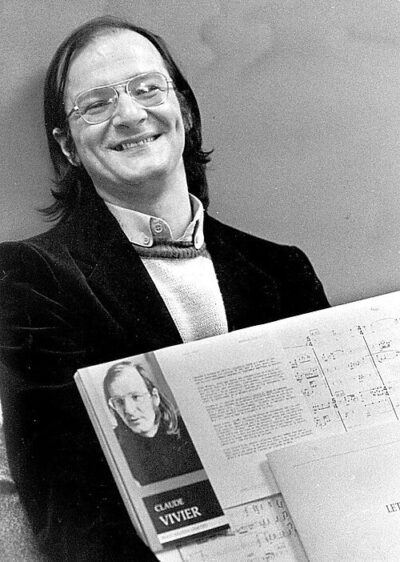
Claude Vivier
Claude Vivier was a Canadian composer. Born April 14, 1948, in Montreal. Died March 7, 1983, in 11th arrondissement of Paris. Educated at Conservatoire de musique du Québec à Montréal.
Facts
11 facts · 2 confirmed by two sources · 3 cited · 6 from one source
What’s different
- Died: we show March 7, 1983 (Confirmed). Wikidata also lists March 12, 1983
Where this comes from
Papalocal keeps its own record. It started from these sources; what each one said is kept here as it was copied, so a change on their side never changes this page by itself. Tap one to read its version.
What Wikidata says · copied November 18, 2026 · revision 2570453630
- Described as
- Canadian composer (1948–1983)
- Born
- April 14, 1948 · 4 references
- Died
- March 7, 1983 · 1 reference; March 12, 1983 · 2 references
- Born in
- Montreal · 2 references
- Died in
- 11th arrondissement of Paris · 2 references
- Citizen of
- Canada
- Occupation
- composer · 1 reference
- Education
- Conservatoire de musique du Québec à Montréal
- Genre
- opera
- Instrument
- piano · 1 reference
- Field
- composer
- Website
- http://www.claudevivier.com/
- Wikipedias with a page
- 16
Wikidata item Q650551 (wikidata.org/wiki/Q650551), public domain (CC0). Copied November 18, 2026.
What Wikipedia says · copied November 18, 2026 · revision 1386459273
Claude Vivier (French: [klod 'vivje] VEEV-yay; baptised as Claude Roger; 14 April 1948 – 7 March 1983) was a Canadian composer, pianist, poet and ethnomusicologist of Québécois origin. After studying with Karlheinz Stockhausen in Cologne, Vivier became an innovative member of the "German Feedback" movement, a subset of what is now known as spectral music. Between 1976 and 1977, Vivier travelled to Egypt, Japan, Iran, Thailand, Singapore, and Bali, where he came under the influence of aspects of their respective traditional musics.
Despite working at a slow pace and leaving behind a small œuvre, Vivier's musical language is vast and diverse. His place in the spectral movement of Europe entailed the manipulation of the harmonic series and led to music that incorporated microtones to replicate these frequencies, a compositional technique he would later refer to as the jeux de couleurs. He is also known for incorporating elements of serialism, dodecaphony, musique concrète, extended techniques, surrealism, traditional Québécois folk songs, and more. The themes of Vivier's pieces are largely seen as autobiographical, often centring around loneliness and ostracization, the search for love and companionship, or voyaging to foreign lands. He used his personal experiences to advance an avant-garde style, having written multilingual vocal music and devising his so-called langues inventées (invented languages). He is considered to be among the greatest composers in Canada's history – György Ligeti would revere Vivier as "the most important and original composer of his generation."
Vivier was openly gay. After ending his brief relationship with Christopher Coe, he frequented Parisian gay bars where he solicited male prostitutes, one of whom violently attacked him in January 1983. Despite warnings from friends and his own increasing paranoia over his safety, Vivier had continued to engage in the same behaviour. On the night of 7 March, he was killed by a serial murderer who routinely deceived gay men in the Marais to rob and assault them.
- Born, in its opening lines
- April 14, 1948
- Died, in its opening lines
- March 7, 1983
From the Wikipedia article “Claude Vivier” (en.wikipedia.org/wiki/Claude_Vivier), by its contributors, under CC BY-SA 4.0 (creativecommons.org/licenses/by-sa/4.0/). Copied November 18, 2026; not changed.
Confirmed Two sources agree. Cited One source, and it names where it got it. One source One source, without a reference of its own. Sources disagree The sources disagree. We show the best-supported value and keep theirs below.
