
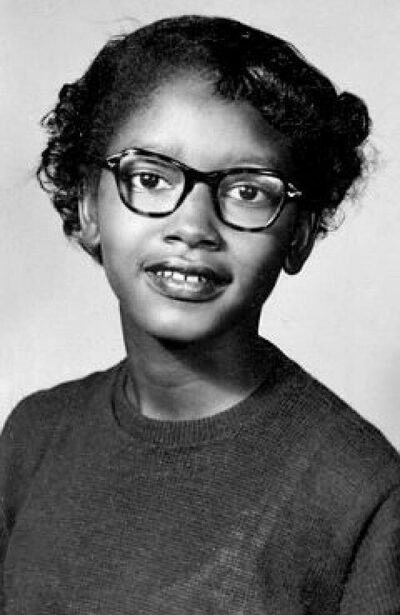
Claudette Colvin
Claudette Colvin was an African-American civil rights activist. Born September 5, 1939, in Montgomery. Died January 13, 2026, in Texas. Positions held include nursing assistant (1969–2004). Educated at Washington High School.
Facts
11 facts · 2 confirmed by two sources · 7 cited · 2 from one source
Where this comes from
Papalocal keeps its own record. It started from these sources; what each one said is kept here as it was copied, so a change on their side never changes this page by itself. Tap one to read its version.
What Wikidata says · copied November 15, 2026 · revision 2568137545
- Described as
- African-American civil rights activist (1939–2026)
- Other names
- Claudette Austin
- Born
- September 5, 1939 · 1 reference
- Died
- January 13, 2026 · 1 reference
- Born in
- Montgomery · 3 references
- Died in
- Texas · 1 reference
- Name at birth
- Claudette Austin · 1 reference
- Citizen of
- United States · 3 references
- Occupation
- civil rights advocate · 1 reference; unlicensed assistive personnel
- Positions held
- nursing assistant (1969–2004) · 1 reference
- Education
- Washington High School · 1 reference
- Member of
- NAACP Youth Council · 3 references
- Wikipedias with a page
- 37
Wikidata item Q468897 (wikidata.org/wiki/Q468897), public domain (CC0). Copied November 15, 2026.
What Wikipedia says · copied November 15, 2026 · revision 1379203714
Claudette Colvin (née Austin; September 5, 1939 – January 13, 2026) was an American pioneer of the 1950s civil rights movement and nurse aide. On March 2, 1955, she was arrested at the age of 15 in Montgomery, Alabama, for refusing to give up her seat to a white woman on a crowded, segregated bus. It occurred nine months before the similar, more widely known incident in which Rosa Parks, secretary of the local chapter of the National Association for the Advancement of Colored People (NAACP), helped spark the 1955 Montgomery bus boycott.
Colvin was one of four plaintiffs in the first federal court case filed by civil rights attorney Fred Gray on February 1, 1956, as Browder v. Gayle, to challenge bus segregation in the city. In a United States district court, Colvin testified before the three-judge panel that heard the case. On June 13, 1956, the judges determined that the state and local laws requiring bus segregation in Alabama were unconstitutional. The case went to the United States Supreme Court on appeal by the state, which upheld the district court's ruling on November 13, 1956. One month later, the Supreme Court affirmed the order to Montgomery and the state of Alabama to end bus segregation. The Montgomery bus boycott was then called off after a few months. The court subsequently declared all segregation on public transportation unconstitutional.
For many years, Montgomery's black leaders did not publicize Colvin's pioneering effort. She said, "Young people think Rosa Parks just sat down on a bus and ended segregation, but that wasn't the case at all." Colvin's case was dropped by civil rights campaigners because she was unmarried and pregnant during the proceedings. It is now widely accepted that she was not accredited by civil rights campaigners due to her circumstances. Rosa Parks said, "If the white press got ahold of that information, they would have [had] a field day. They'd call her a bad girl, and her case wouldn't have a chance."
In 2021, the record of Colvin's arrest and adjudication of delinquency was expunged by the district court in the county where the charges against her had been brought more than 66 years earlier.
- Born, in its opening lines
- September 5, 1939
- Died, in its opening lines
- January 13, 2026
From the Wikipedia article “Claudette Colvin” (en.wikipedia.org/wiki/Claudette_Colvin), by its contributors, under CC BY-SA 4.0 (creativecommons.org/licenses/by-sa/4.0/). Copied November 15, 2026; not changed.
Confirmed Two sources agree. Cited One source, and it names where it got it. One source One source, without a reference of its own. Sources disagree The sources disagree. We show the best-supported value and keep theirs below.
