
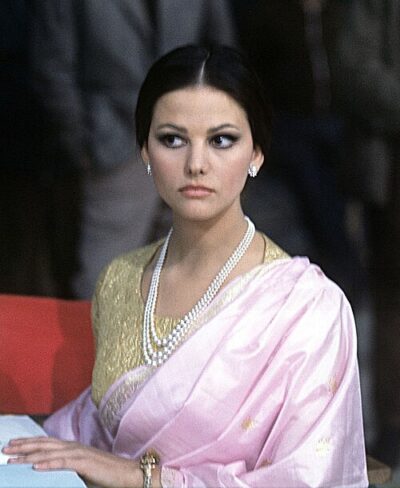
Claudia Cardinale
Claudia Cardinale was an Italian actress. Born April 15, 1938, in La Goulette. Died September 23, 2025, in Nemours. Positions held include UNESCO Goodwill Ambassador. Educated at Experimental Centre of Cinematography. Awards include Commander of the Order of Merit of the Italian Republic, Grand Officer of the Order of Merit of the Italian Republic and Steiger Award.
Facts
32 facts · 2 confirmed by two sources · 11 cited · 19 from one source
Where this comes from
Papalocal keeps its own record. It started from these sources; what each one said is kept here as it was copied, so a change on their side never changes this page by itself. Tap one to read its version.
What Wikidata says · copied November 16, 2026 · revision 2569138418
- Described as
- Italian actress (1938–2025)
- Other names
- Claude Cardinale, Claude Joséphine Rose Cardinale
- Born
- April 15, 1938 · 9 references
- Died
- September 23, 2025 · 4 references
- Born in
- La Goulette · 1 reference
- Died in
- Nemours · 4 references
- Name at birth
- Claude Joséphine Rose Cardinale
- Citizen of
- Italy; France · 2 references
- Occupation
- film actor · 1 reference; actor · 3 references; stage actor · 1 reference
- Positions held
- UNESCO Goodwill Ambassador
- Education
- Experimental Centre of Cinematography
- Genre
- Western
- Instrument
- voice
- Awards
- Commander of the Order of Merit of the Italian Republic (1995) · 1 reference; Grand Officer of the Order of Merit of the Italian Republic (2002) · 1 reference; Steiger Award; David di Donatello Award for Lifetime Achievement (1997); Commander of the Legion of Honour; Golden Orange Best Actress Award; Honorary Golden Bear (2002); David di Donatello for Best Actress; Flaiano Prize; Nastro d'Argento for Best Actress (2 times) (1965, 1985); Nastro d'Argento for Best Supporting Actress; Golden Lion for Lifetime Achievement (1993); Commandeur des Arts et des Lettres · 1 reference; Grand Officer of the Legion of Honour · 1 reference; Officer of the Legion of Honour · 1 reference
- Field
- acting · 1 reference
- Spouse
- Franco Cristaldi (1966–1975) · 1 reference
- Height
- 1.73 m (5 ft 8 in) · 1 reference
- Wikipedias with a page
- 89
Wikidata item Q107006 (wikidata.org/wiki/Q107006), public domain (CC0). Copied November 16, 2026.
What Wikipedia says · copied November 16, 2026 · revision 1383038458
Claude Joséphine Rose "Claudia" Cardinale (Italian: [ˈklaudja kardiˈnaːle]; 15 April 1938 – 23 September 2025) was an Italian-Tunisian actress. Regarded as one of the leading female figures of Italian cinema, alongside Sophia Loren, Monica Vitti, Silvana Mangano, Anna Magnani, and Gina Lollobrigida, she achieved international recognition during a career spanning more than six decades. Celebrated in the 1960s as "the most beautiful woman in the world" and widely considered a sex symbol of the era, Cardinale appeared in more than 175 films, primarily in Italy and France, across genres including comedy, drama, spaghetti westerns, and historical epics. She collaborated with acclaimed directors such as Federico Fellini, Sergio Leone, Luchino Visconti and Werner Herzog, and several of her films are regarded as significant works in the history of cinema. At the time of her death, she was one of the last surviving stars from the Golden Age of European cinema.
Cardinale was born and raised in La Goulette, a municipality in Tunisia near Tunis. She won the "Most Beautiful Italian Girl in Tunisia" competition in 1957, the prize being a trip to Italy. This move quickly led to film contracts, due above all to the involvement of producer Franco Cristaldi, who acted as her mentor for a number of years and later married her. After making her debut in a minor role with Egyptian star Omar Sharif in Goha (1958), Cardinale became one of the best-known actresses in Italy, with roles in films such as Rocco and His Brothers (1960), Girl with a Suitcase (1961), Cartouche (1962), The Leopard (1963) and Federico Fellini's 8½ (1963).From 1963, Cardinale appeared in The Pink Panther opposite David Niven. She went on to appear in the Hollywood films Blindfold (1966), Lost Command (1966), The Professionals (1966), Don't Make Waves (1967) with Tony Curtis, The Hell with Heroes (1968), The Red Tent (1969), A Fine Pair (1968), The Salamander (1981), and the Sergio Leone Western Once Upon a Time in the West (1968), a joint U.S.–Italian production, in which she was praised for her role as a former prostitute opposite Jason Robards, Charles Bronson and Henry Fonda.
Jaded with Hollywood, and not wanting to become a cliché, Cardinale returned to Italian and French cinema and garnered the David di Donatello for Best Actress award for her roles in The Day of the Owl (1968) and as a prostitute alongside Alberto Sordi in A Girl in Australia (1971). In 1974, Cardinale met director Pasquale Squitieri, who would become her partner. She was frequently featured in his films, including Blood Brothers (1974), Father of the Godfathers (1978) and Claretta (1984), the last of which won her the Nastro d'Argento Award for Best Actress. In 1982, she co-starred with Klaus Kinski in Werner Herzog's Fitzcarraldo. In 2010, Cardinale received the Best Actress Award at the 47th Antalya "Golden Orange" International Film Festival for her performance as an elderly Italian woman who takes in a young Turkish exchange student in Signora Enrica.
Over the years, Cardinale was outspoken about women's rights and became a UNESCO goodwill ambassador for the Defence of Women's Rights beginning in March 2000. In February 2011, the Los Angeles Times Magazine named Cardinale among the 50 most beautiful women in film history.
- Born, in its opening lines
- April 15, 1938
- Died, in its opening lines
- September 23, 2025
From the Wikipedia article “Claudia Cardinale” (en.wikipedia.org/wiki/Claudia_Cardinale), by its contributors, under CC BY-SA 4.0 (creativecommons.org/licenses/by-sa/4.0/). Copied November 16, 2026; not changed.
Confirmed Two sources agree. Cited One source, and it names where it got it. One source One source, without a reference of its own. Sources disagree The sources disagree. We show the best-supported value and keep theirs below.
