
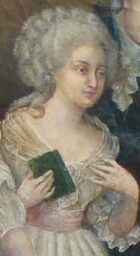
Claudine Picardet
Claudine Picardet was a French chemist, mineralogist, meteorologist and translator. Born August 7, 1735, in Dijon. Died October 4, 1820, in Paris. Awards include 72 scientist women names on the Eiffel tower.
Facts
13 facts · 2 confirmed by two sources · 2 cited · 9 from one source
Where this comes from
Papalocal keeps its own record. It started from these sources; what each one said is kept here as it was copied, so a change on their side never changes this page by itself. Tap one to read its version.
What Wikidata says · copied November 18, 2026 · revision 2564294680
- Described as
- French chemist, mineralogist, meteorologist and translator (1735-1820)
- Other names
- Claudine Guyton de Morveau
- Born
- August 7, 1735 · 1 reference
- Died
- October 4, 1820 · 1 reference
- Born in
- Dijon · 1 reference
- Died in
- Paris · 1 reference
- Name at birth
- Claudine Poullet
- Citizen of
- France
- Occupation
- chemist; mineralogist; meteorologist; translator
- Awards
- 72 scientist women names on the Eiffel tower
- Spouse
- Claude Picardet (1755–1794); Louis-Bernard Guyton de Morveau (1798–1816)
- Wikipedias with a page
- 23
Wikidata item Q14125842 (wikidata.org/wiki/Q14125842), public domain (CC0). Copied November 18, 2026.
What Wikipedia says · copied November 18, 2026 · revision 1384131330
Claudine Picardet, born Poullet, later Guyton de Morveau (French: [klodin pikaʁdɛ]; 7 August 1735 – 4 October 1820), was a French chemist, mineralogist, meteorologist and scientific translator. Among the French chemists of the late eighteenth century she stands out for her extensive translations of scientific literature from Swedish, English, German and Italian to French. She translated three books and thousands of pages of scientific papers, which were published as well as circulated in manuscript form. She hosted renowned scientific and literary salons in Dijon and Paris, and was an active participant in the collection of meteorological data. She helped to establish Dijon and Paris as scientific centers, substantially contributing to the spread of scientific knowledge during a critical period in the chemical revolution.
Due to the work of both Claudine Picardet and her second husband Louis-Bernard Guyton de Morveau that Dijon was recognised internationally as a scientific center. As one of the two most prolific translators in chemistry during the 1780s, Madame Picardet increased the availability of chemical knowledge at a crucial time during the chemical revolution, particularly the knowledge of salts and minerals. Her activities supported the publication of specialised scientific journals and helped to establish the use of editorial features such as the date of first publication. The value of her work as a translator was recognized by scholars of her time both nationally and internationally.
- Born, in its opening lines
- August 7, 1735
- Died, in its opening lines
- October 4, 1820
From the Wikipedia article “Claudine Picardet” (en.wikipedia.org/wiki/Claudine_Picardet), by its contributors, under CC BY-SA 4.0 (creativecommons.org/licenses/by-sa/4.0/). Copied November 18, 2026; not changed.
Confirmed Two sources agree. Cited One source, and it names where it got it. One source One source, without a reference of its own. Sources disagree The sources disagree. We show the best-supported value and keep theirs below.
