
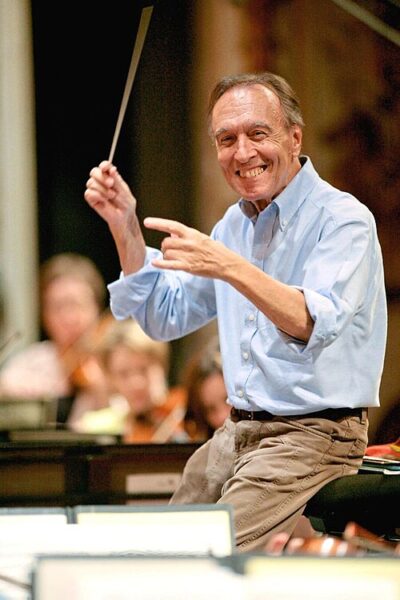
Claudio Abbado
Claudio Abbado was an Italian conductor. Born June 26, 1933, in Milan. Died January 20, 2014, in Bologna. Positions held include Italian senator for life (2013–2014). Educated at Milan Conservatory and Accademia Musicale Chigiana. Awards include Knight Grand Cross of the Order of Merit of the Italian Republic, Grand Cross of the Legion of Honour and Ring of Honour of the City of Vienna.
Facts
47 facts · 2 confirmed by two sources · 19 cited · 26 from one source
Where this comes from
Papalocal keeps its own record. It started from these sources; what each one said is kept here as it was copied, so a change on their side never changes this page by itself. Tap one to read its version.
What Wikidata says · copied November 16, 2026 · revision 2566152678
- Described as
- Italian conductor (1933–2014)
- Born
- June 26, 1933 · 13 references
- Died
- January 20, 2014 · 16 references
- Born in
- Milan · 4 references
- Died in
- Bologna · 3 references
- Buried in
- Cemetery of the Fex-Crasta chapel
- Cause of death
- disease
- Citizen of
- Kingdom of Italy (–1946); Italy (1946–)
- Occupation
- conductor · 1 reference; politician · 1 reference; pianist · 1 reference; music director; composer; musician · 1 reference
- Positions held
- Italian senator for life (2013–2014) · 1 reference
- Worked for
- Accademia Nazionale di Santa Cecilia
- Education
- Milan Conservatory; Accademia Musicale Chigiana; University of Music and Performing Arts Vienna
- Member of
- Berlin Philharmonic
- Genre
- classical music; opera
- Instrument
- piano
- Record label
- Deutsche Grammophon
- Awards
- Knight Grand Cross of the Order of Merit of the Italian Republic (1984) · 1 reference; Grand Cross of the Legion of Honour; Ring of Honour of the City of Vienna; Great Golden Medal of Honour for Services to the Republic of Austria; Ernst Reuter Medal (2004) · 1 reference; Praemium Imperiale (2003) · 1 reference; Gramophone Award for Lifetime Achievement (2012) · 1 reference; Gramophone Award for Recording of the Year (2015) · 1 reference; Royal Philharmonic Society Gold Medal (2003); Grammy Awards; honorary doctorate from the University of Cambridge; honorary doctor of the University of Aberdeen; Ernst von Siemens Music Prize (1994) · 1 reference; Hans von Bülow Medal · 1 reference; Knight Commander's Cross of the Order of Merit of the Federal Republic of Germany (2002) · 1 reference
- Spouse
- Giovanna Cavazzoni (1956–1968) · 1 reference
- Children
- Daniele Abbado · 1 reference; Alessandra Abbado · 1 reference
- Father
- Michelangelo Abbado · 1 reference
- Mother
- Maria Carmela Savagnone
- Siblings
- Marcello Abbado · 1 reference; Gabriele Abbado · 1 reference; Luciana Pestalozza Abbado · 1 reference
- Wikipedias with a page
- 65
Wikidata item Q151608 (wikidata.org/wiki/Q151608), public domain (CC0). Copied November 16, 2026.
What Wikipedia says · copied November 16, 2026 · revision 1380139738
Claudio Abbado (Italian pronunciation: [ˈklaudjo abˈbaːdo]; 26 June 1933 – 20 January 2014) was an Italian conductor who was one of the leading conductors of his generation. He served as music director of the La Scala opera house in Milan, principal conductor of the Berlin Philharmonic, principal conductor of the London Symphony Orchestra, principal guest conductor of the Chicago Symphony Orchestra, music director of the Vienna State Opera, founder and director of the Lucerne Festival Orchestra, founder and director of the Mahler Chamber Orchestra, founding artistic director of the Orchestra Mozart and music director of the European Union Youth Orchestra. He was recipient of the Ernst von Siemens Music Prize and Senator for life in Italy.
- Born, in its opening lines
- June 26, 1933
- Died, in its opening lines
- January 20, 2014
From the Wikipedia article “Claudio Abbado” (en.wikipedia.org/wiki/Claudio_Abbado), by its contributors, under CC BY-SA 4.0 (creativecommons.org/licenses/by-sa/4.0/). Copied November 16, 2026; not changed.
Confirmed Two sources agree. Cited One source, and it names where it got it. One source One source, without a reference of its own. Sources disagree The sources disagree. We show the best-supported value and keep theirs below.
