
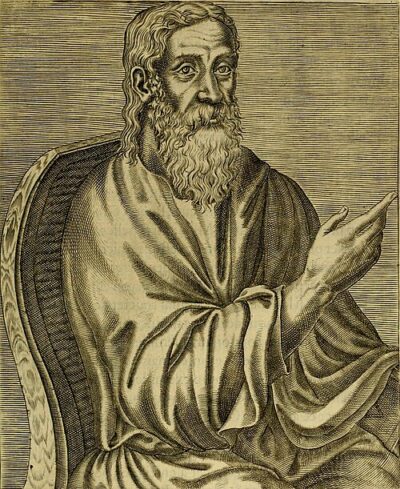
Clement of Alexandria
Clement of Alexandria was a Christian theologian (c.150 – c.215). Born 150, in Athens. Died 215, in Kayseri. Known for Protrepticus and Excerpts of Theodotus. Educated at Catechetical School of Alexandria.
Facts
14 facts · 0 confirmed by two sources · 4 cited · 10 from one source
Where this comes from
Papalocal keeps its own record. It started from these sources; what each one said is kept here as it was copied, so a change on their side never changes this page by itself. Tap one to read its version.
What Wikidata says · copied November 16, 2026 · revision 2567481334
- Described as
- Christian theologian (c.150 – c.215)
- Other names
- Saint Clement, Titus Flavius Clemens
- Born
- 150 · 5 references
- Died
- 215 · 7 references
- Born in
- Athens · 1 reference
- Died in
- Kayseri
- Name at birth
- Κλήμης ὁ Ἀλεξανδρεύς
- Citizen of
- Ancient Rome
- Occupation
- theologian; philosopher; writer · 1 reference
- Education
- Catechetical School of Alexandria
- Known for
- Protrepticus; Excerpts of Theodotus
- Religion
- Christianity
- Lived in
- Alexandria
- Wikipedias with a page
- 76
Wikidata item Q188883 (wikidata.org/wiki/Q188883), public domain (CC0). Copied November 16, 2026.
What Wikipedia says · copied November 16, 2026 · revision 1380591780
Titus Flavius Clemens, also known as Clement of Alexandria (Ancient Greek: Κλήμης ὁ Ἀλεξανδρεύς; c. 147 – c. 215 AD), was a Christian theologian and philosopher who taught at the Catechetical School of Alexandria. Among his pupils were Origen and Alexander of Jerusalem. A convert to Christianity, he was an educated man who was familiar with classical Greek philosophy and literature. As his three major works demonstrate, Clement was influenced by Hellenistic philosophy to a greater extent than any other Christian thinker of his time, and in particular, by Plato and the Stoics. His secret works, which exist only in fragments, suggest that he was familiar with pre-Christian Jewish esotericism and Gnosticism as well. In one of his works he argued that Greek philosophy had its origin among non-Greeks, claiming that both Plato and Pythagoras were taught by Egyptian scholars.
Clement is usually regarded as a Church Father. He is venerated as a saint in Coptic Christianity, Eastern Catholicism, Ethiopian Christianity, and Anglicanism. He was revered in Western Catholicism until 1586, when his name was removed from the Roman Martyrology by Pope Sixtus V on the advice of Baronius. The Eastern Orthodox Church officially stopped any veneration of Clement of Alexandria in the 10th century. Nonetheless, he is still sometimes referred to as "Saint Clement of Alexandria" by both Eastern Orthodox and Catholic authors.
From the Wikipedia article “Clement of Alexandria” (en.wikipedia.org/wiki/Clement_of_Alexandria), by its contributors, under CC BY-SA 4.0 (creativecommons.org/licenses/by-sa/4.0/). Copied November 16, 2026; not changed.
Confirmed Two sources agree. Cited One source, and it names where it got it. One source One source, without a reference of its own. Sources disagree The sources disagree. We show the best-supported value and keep theirs below.
