
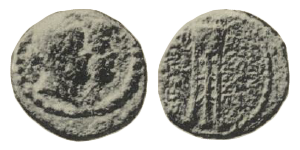
Cleopatra Selene of Egypt and Syria
Cleopatra Selene of Egypt and Syria was a queen of Egypt and Syria. Born 135 BC. Died 69 BC, in Seleucia at the Zeugma. Positions held include Seleucid ruler.
Facts
23 facts · 0 confirmed by two sources · 1 cited · 21 from one source · 1 where the sources disagree
What’s different
- Born: we show 135 BC (Sources disagree). Wikidata also lists 131 BC
Where this comes from
Papalocal keeps its own record. It started from these sources; what each one said is kept here as it was copied, so a change on their side never changes this page by itself. Tap one to read its version.
What Wikidata says · copied November 16, 2026 · revision 2568990113
- Described as
- queen of Egypt and Syria
- Other names
- Cleopatra V
- Born
- 135 BC; 131 BC
- Died
- 69 BC · 1 reference
- Died in
- Seleucia at the Zeugma
- Citizen of
- Ancient Egypt
- Occupation
- queen regnant
- Positions held
- Seleucid ruler
- Spouse
- Ptolemy IX Lathyros; Antiochus VIII Grypus; Antiochus IX Cyzicenus; Antiochus X Eusebes; Ptolemy X Alexander I
- Children
- Seleucus VII Kybiosaktes; Antiochus XIII Asiaticus; Berenice III; Demetrius III Eucaerus
- Father
- Ptolemy VIII Physcon
- Mother
- Cleopatra III of Egypt
- Siblings
- Cleopatra IV of Egypt; Tryphaena; Ptolemy Memphites; Ptolemy IX Lathyros; Ptolemy X Alexander I; Ptolemy Apion
- Wikipedias with a page
- 35
Wikidata item Q40027 (wikidata.org/wiki/Q40027), public domain (CC0). Copied November 16, 2026.
What Wikipedia says · copied November 16, 2026 · revision 1365283885
Cleopatra Selene (Ancient Greek: Κλεοπάτρα Σελήνη; c. between 135 and 130 – 69 BC) was the Queen consort of Egypt (Cleopatra Selene or Cleopatra V Selene) from 115 to 102 BC, the Queen consort of Syria from 102 to 92 BC, and the monarch of Syria (Cleopatra II) from 82 to 69 BC. The daughter of Ptolemy VIII Physcon and Cleopatra III of Egypt, Cleopatra Selene was favoured by her mother and became a pawn in Cleopatra III's political manoeuvres. In 115 BC, Cleopatra III forced her son Ptolemy IX to divorce his sister-wife Cleopatra IV, and chose Cleopatra Selene as the new queen consort of Egypt. Tension between the king and his mother grew and ended with his expulsion from Egypt, leaving Cleopatra Selene behind; she probably then married the new king, her other brother Ptolemy X.
Following the marriage of the Syrian Seleucid princess Cleopatra I to Ptolemy V of Egypt, dynastic marriages between the two kingdoms became common. In 102 BC, Cleopatra III decided to establish an alliance with her nephew Antiochus VIII of Syria; Cleopatra Selene was sent as his bride. After his assassination in 96 BC, she married his brother and rival Antiochus IX. Cleopatra Selene lost her new husband in 95 BC and married a final time to Antiochus IX's son Antiochus X, who disappeared from the records and is presumed to have died in 92 BC, but may have remained in power until 89/88 BC (224 SE (Seleucid year)). Cleopatra Selene then hid somewhere in the kingdom with her children. Eventually, Syria split between the sons of Antiochus VIII with Philip I ruling in the Syrian capital Antioch and Antiochus XII in the southern city Damascus.
Cleopatra Selene had many children by several husbands. Probably following the death of Antiochus XII in 230 SE (83/82 BC), she declared Antiochus XIII, her son by Antiochus X, king, and seems to have declared herself co-ruler; they claimed Antioch following Philip I's death. But the people of Antioch and the governor of Damascus, exhausted by the Seleucids' civil wars, invited foreign monarchs to rule them: Tigranes II of Armenia took Antioch, while Aretas III of Nabataea took Damascus. Cleopatra Selene controlled several coastal towns until Tigranes II besieged her in 69 BC in Ptolemais; the Armenian king captured the queen and later executed her.
From the Wikipedia article “Cleopatra Selene of Syria” (en.wikipedia.org/wiki/Cleopatra_Selene_of_Syria), by its contributors, under CC BY-SA 4.0 (creativecommons.org/licenses/by-sa/4.0/). Copied November 16, 2026; not changed.
Confirmed Two sources agree. Cited One source, and it names where it got it. One source One source, without a reference of its own. Sources disagree The sources disagree. We show the best-supported value and keep theirs below.
